Published by TrenBuzz.com | May 15, 2026
Key Points at a Glance – America’s Debt Just Crossed GDP for the First Time
- US public debt hit $31.27 trillion — edging past GDP of $31.22 trillion for the first time since World War II.
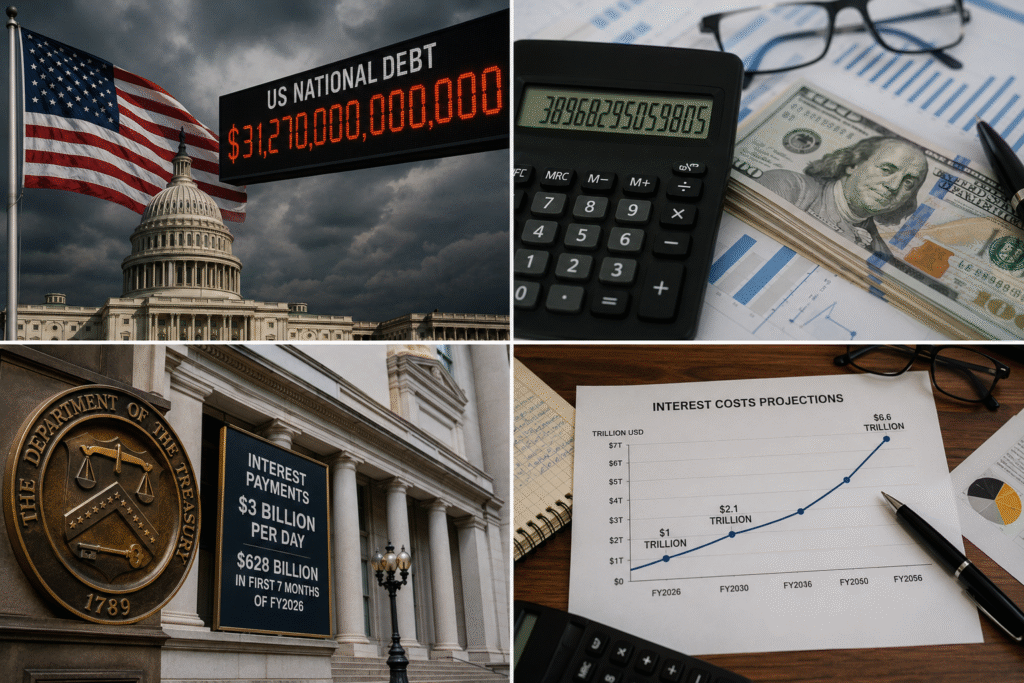
- The overall gross debt is approaching $39 trillion — at $38,968,295,059,805 as of May 13.
- The US Treasury is now paying $3 billion per day — or $628 billion in just the first seven months of FY2026 — in interest alone.
- Interest payments now exceed both Medicare AND the Pentagon’s defense budget combined for the same period.
- By FY2028, interest costs will exceed Medicare spending. By FY2038, they will surpass all discretionary defense and non-defense spending.
- Moody’s just downgraded the US credit rating from Aaa to Aa1 — making the US the only major economy rated below the highest tier by all three major agencies.
- CBO projects interest costs will double from $1 trillion today to $2.1 trillion by 2036 — and explode to $6.6 trillion by 2056.
- Interest costs already represent 18.6% of federal revenue — up from a historical average of around 2.1% of GDP.
- Markets haven’t panicked — yet. The milestone was described by Northeastern economists as “non-news” since it was long anticipated.
- CRFB President Maya MacGuineas warned: “We are clearly on an unsustainable fiscal path. We need to do better.”
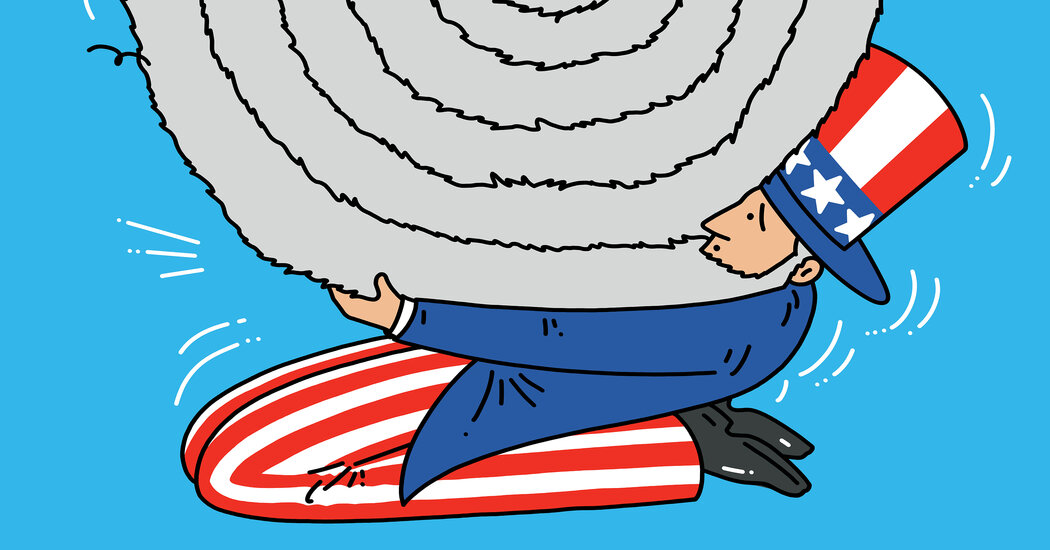
The milestone finally arrived. The United States of America now owes more money than its entire economy produces in a year. And yet — that’s not the headline that should keep you up at night.
Debt held by the public stood at $31.27 trillion at the end of April, edging above US GDP of $31.22 trillion between April 2025 and March 2026, according to a recent analysis by the Committee for a Responsible Federal Budget. “Outside of a brief period early in the COVID-19 pandemic — when GDP temporarily crashed — debt only exceeded GDP for two years at the end of World War II,” found the nonpartisan think tank.
The Real Problem — $3 Billion Per Day Just in Interest
The US Treasury has paid $628 billion in net interest in the first seven months of fiscal year 2026 alone — roughly $3 billion every single day. Net interest on public debt is now a larger figure than both Medicare and Medicaid combined for the same period, totaling $628 billion versus $588 billion for Medicare and $409 billion for Medicaid.
The CBO projects that net interest payments will more than double, rising from $1.0 trillion in FY2026 to $2.0 trillion in FY2036. Over the long term, those interest costs will grow to $3.8 trillion by FY2046 and to $6.6 trillion by FY2056 — a staggering 538% increase over the 30-year window.
Why Markets Haven’t Panicked — Yet
“It was, in a sense, as far as the market’s concerned, non-news,” said Bob Triest, professor of economics at Northeastern University, explaining that markets had already “priced in” such an event because the milestone was long expected. Stock indexes reached record highs following the news and continued to rise.
The key reassurance for investors: economists note that the US economy has grown at a faster rate than the average interest paid on debt during four of the last five years — a “positive gap that should keep the growth of the debt-to-GDP ratio in check,” according to JPMorgan Chase. And US debt remains in high demand globally.
Moody’s Drops the Hammer — America Loses Its Last AAA
In May 2026, Moody’s became the third of the three major ratings agencies to downgrade the US credit rating from its highest tier, lowering it from Aaa to Aa1. The firm noted that the cost of interest payments on the debt is projected to rise from 9% of federal revenue to 30% of federal revenue by 2035. “Successive US administrations and Congress have failed to agree on measures to reverse the trend of large annual fiscal deficits and growing interest costs,” Moody’s wrote.
The Tipping Point Nobody Can Define — But Everyone Fears
Given the latest inflation rate of 3.8%, and with the debt projected to increase at the rate it’s been increasing, at some point a threshold — “which no one seems to have a good sense of,” according to Northeastern economist Mark Hooker — will be crossed where “interest rates will get a lot higher.” Those higher interest rates could make the debt grow even faster than the CBO projects, increasing the debt-to-GDP ratio even more.
Romina Boccia of the Cato Institute responded to Trump’s $1.5 trillion defense budget request: “Excessive debt slows economic growth, reduces income levels, raises interest rates, and constrains funding for core government functions, like national defense. Financing a larger military by borrowing yet more, when interest costs on the existing debt already exceed what the nation spends on defense, becomes fiscally untenable.”
What Actually Needs to Change
“The current federal debt is clearly unsustainable, no matter how many times the debt ceiling is raised,” Jonathan Williams of ALEC told CBS News. “If Congress doesn’t start implementing fiscally responsible policies in a nonpartisan fashion, Americans will pay the price in higher taxes and slowed economic growth and in the form of ugly price inflation.”
The debt crossing GDP is a historic milestone. But the real catastrophe is quieter and slower — and it’s measured not in one number, but in the $3 billion that leaves the US Treasury every single day to pay the bill for decisions made yesterday, while there’s less and less left to invest in tomorrow.
Disclaimer: This article is for general informational and educational news reporting purposes only. All debt figures, GDP data, and interest payment calculations are sourced from the Congressional Budget Office, US Treasury Department, Peter G. Peterson Foundation, Committee for a Responsible Federal Budget, Fortune, CBS News, Fox Business, and Northeastern University as of May 13–15, 2026. TrenBuzz.com does not provide financial, investment, or fiscal policy advice. Readers are encouraged to consult qualified economists and follow official government budget sources for the most current fiscal data.