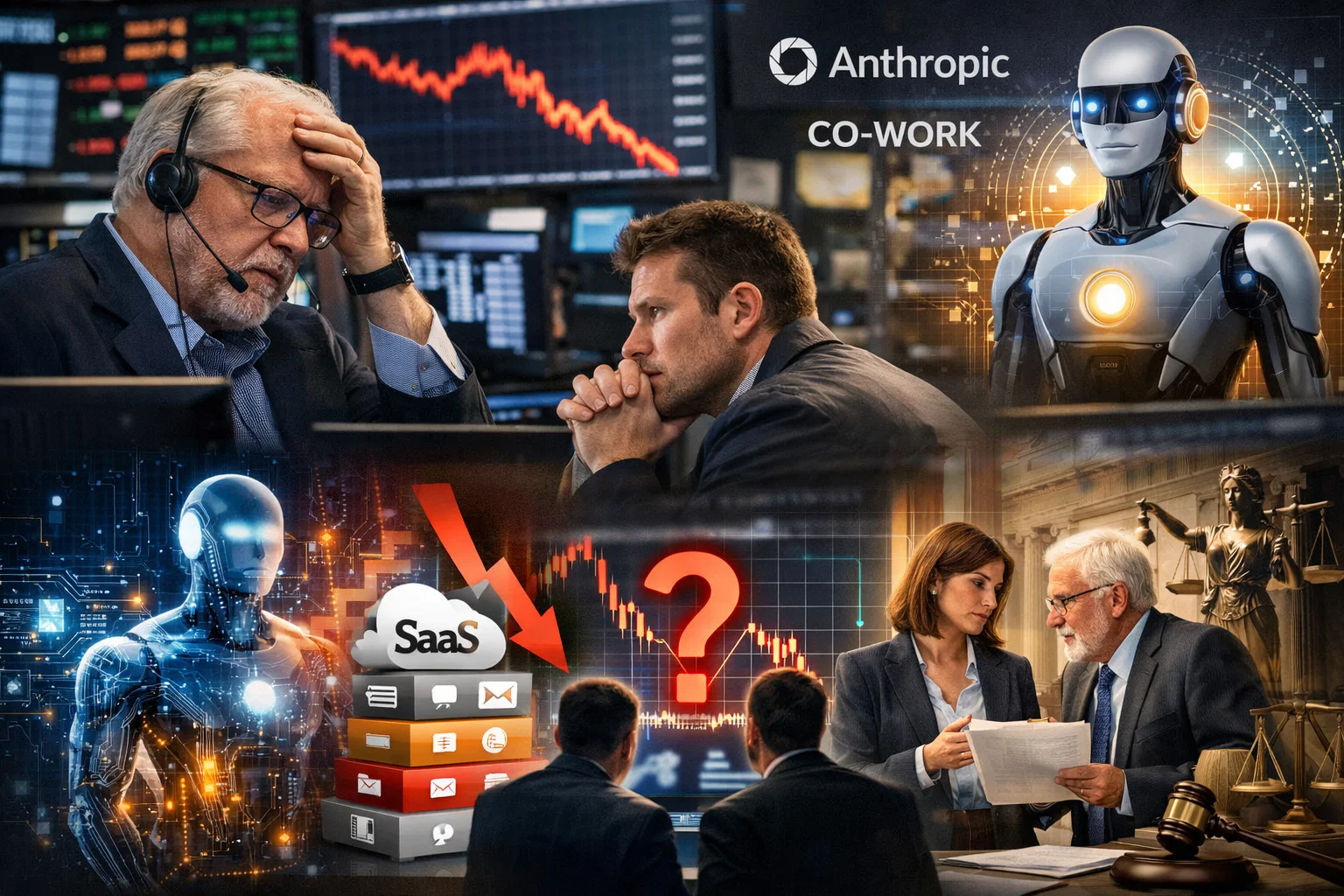
- The immediate trigger was Anthropic’s Claude CoWork announcement — investors read it as a fast, practical AI agent that threatens large swathes of enterprise software revenue.
- The selloff wiped hundreds of billions from software market caps as traders rotated away from traditional SaaS into AI-platform winners.
- Legal and regulatory uncertainty around Anthropic (copyright settlements, lawsuits) amplified fear that business models and costs for AI will remain unsettled.
- The core question for investors: are these moves a re-pricing of durable disruption — or a panic that overshoots opportunity? The answer determines whether the selloff is over.
Snapshot — what happened this week
Global software and IT-services stocks tumbled after market participants digested Anthropic’s new Claude CoWork agent and fast follow-up commentary that AI agents can do real, repeatable work previously billed as software or services.
Major enterprise names and niche SaaS vendors alike saw sharp drawdowns as the market re-rated exposure to automation risk.
The proximate trigger: Claude CoWork (and why it matters)
Anthropic’s CoWork feature stitches agents into workflows — legal drafting, research, code scaffolding, and other repeatable tasks — and investors feared it could materially shorten incumbents’ revenue runways.
When a recognizable AI company ships something that looks enterprise-ready, traders often ask: how many human billable hours does this replace? That arithmetic sank software multiples this week.
Why the drop went beyond a single product launch
Two reinforcing dynamics turned a product shock into a sector slump:
- Crowded exposure: many software names sell recurring human-intensive workflows (legal, accounting, consulting) that agents target.
- Narrative momentum: rapid headlines and fund-level de-risking can turn a valuation repricing into a cascade. Analysts call it a “shadow of uncertainty” — not all fundamentals changed overnight, but perceived timing and scale of disruption did.
Legal and cost clouds make the story stickier
Anthropic still faces the aftermath of a multibillion-dollar copyright dispute and settlement negotiations, which remind investors that the cost, licensing and legal risks of agent training are unresolved.
That uncertainty raises two problems for buyers and vendors alike: higher operating costs (licensing, indemnities) and unclear product roadmaps while legal issues are litigated or settled.
Market impact — how big was the hit?
Traders and outlets reported the collective drawdown in software indices and estimates that the rout erased large fractions of market value across U.S., European and Asian software names.
Bloomberg and the Wall Street Journal flagged multi-week losses and a rotating flight to platform leaders and non-tech defensive sectors as the re-risking continued.

Why some stocks fell harder (and who was sheltered)
Firms whose value depends on labour-intensive services or predictable upgrade cycles (traditional ERP, legal research publishers, outsourcers) looked especially vulnerable.
By contrast, companies tightly coupled to AI stacks (chipmakers, cloud-inference platforms) or with clear differentiated moats fared better — investors are buying exposure to the underlying compute and models rather than the old SaaS wrappers.
Indicators that would signal the selloff is ending
Watch for these concrete signs:
- Management guidance that preserves revenue visibility (firm bookings, stickiness metrics).
- Evidence that clients are adopting rather than replacing software (i.e., uplift in ARPU from AI add-ons).
- Legal clarity on training data costs and licensing that reduces tail risk for enterprise contracts.
What investors can — and shouldn’t — do right now
Do: reassess exposure to labor-replacement risk, check bundled-service margins, and prefer companies showing durable pricing power or clear AI-augmentation paths.
Don’t: assume every headline means permanent obsolescence — many software businesses evolve into hybrid models (human+AI) that remain valuable. Timing your entry requires watching adoption and margin trajectories.
Quick FAQ — short answers readers want
Is Anthropic the enemy of software?
No — Anthropic is one agent-maker whose product accelerated a revaluation. The long arc is about how enterprises integrate agents into stacks; incumbents can adapt, partner, or be displaced depending on execution.
Are these moves a buying opportunity for software value investors?
Possibly — if you can differentiate between secularly at-risk business lines and those with strong moats or AI-augmentation strategies, the dip creates selective opportunities.
Will Anthropic go public or is there an ‘Anthropic stock’ to buy?
Anthropic remained private as of January 2026; some market stories speculate on valuation and funding, but public investors currently access the AI theme through cloud, chip and software platform leaders.
Is the software selloff over — or just getting started?
Bottom line — a cautious verdict
The selloff reflects a genuine re-risking: Anthropic’s product moves plus unresolved legal questions created a ‘now-or-never’ reconsideration of SaaS economics.
But it’s not necessarily permanent. If enterprises adopt agents as augmentors rather than outright replacements — and if legal/regulatory clarity emerges — valuations could stabilize and selective buying opportunities will open. Monitor adoption metrics, enterprise guidance, and legal developments to judge whether the shock settles into a new equilibrium.
Disclaimer: Market conditions and company developments change rapidly. This article summarizes contemporaneous reporting and is not financial advice. Investors should consult primary filings, company guidance and professional advisers before making investment decisions.