Key Points: Baby Boomer Social Security Returns
- Baby boomer Social Security returns now average 265 percent of what workers personally paid into the system, according to new CRFB analysis.
- A median wage retiree in 2027 will collect roughly 730,000 dollars in lifetime benefits after contributing less than 200,000 dollars themselves.
- The real driver is not generational unfairness, it is a worker to beneficiary ratio that has collapsed from 16 to 1 down to under 3 to 1.
- Every generation of retirees since the 1940s has received a similarly favorable deal, a detail most headlines have left out entirely.
Baby Boomer Social Security Returns Are Real, But The Story Isn’t Simple
Baby boomer Social Security returns have become a genuinely eye catching statistic this week, and the raw number deserves attention. What most coverage is skipping is the context that actually explains why this happened, and why it isn’t really a boomer specific story at all.
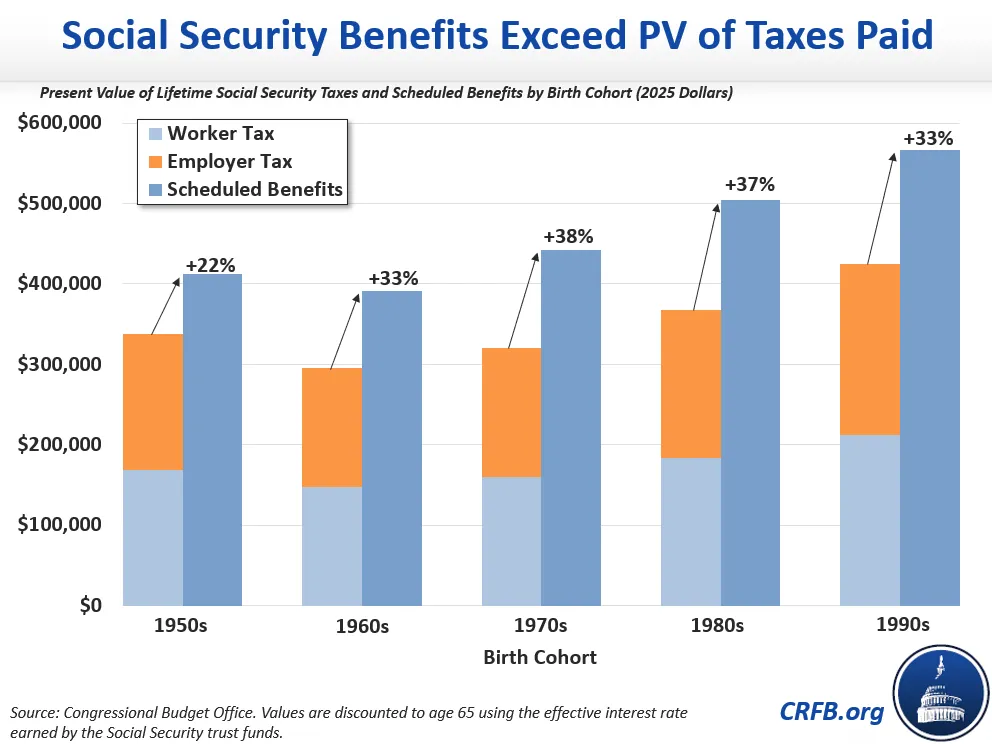
A new analysis from the nonpartisan Committee for a Responsible Federal Budget found retirees this decade will collect about 133 percent of everything they and their employers paid in combined taxes. Strip out the employer share, and that number climbs to roughly 265 percent of what workers personally contributed.
The Numbers Behind The Headline
In dollar terms, the gap is dramatic. A median wage worker retiring in 2027 can expect approximately 730,000 dollars in lifetime Social Security benefits, compared to less than 200,000 dollars paid in taxes by that worker and their employer combined.
Benefits actually surpass total taxes paid after just six years of collecting checks. They surpass the retiree’s own personal contribution after only three years, meaning most of a typical retirement’s total payout arrives well after the break even point has already passed.
The Detail Most Coverage Is Skipping
Here is the part of this story that deserves far more attention than the eye catching percentage itself. CRFB’s own analysis notes clearly that every generation of retirees since the 1940s has received a similarly favorable deal, back when the ratio of workers to beneficiaries was even more generous.
That means this is not a story about baby boomers uniquely gaming the system. It is a structural feature baked into Social Security since its creation, one that boomers benefit from today largely because of decisions made decades before most of them ever paid a single payroll tax.
Boomers also spent decades contributing to the trust fund surplus that is now being drawn down to help cover today’s shortfall, a detail that complicates any simple framing of one generation taking from another.
Why The Math Actually Works This Way
The real mechanical explanation comes down to a shrinking ratio. In 1950, more than 16 covered workers supported every single beneficiary. By 1960, that number had fallen to about 5 to 1. Today it sits around 2.7 workers per beneficiary, and continues declining.
Social Security was built as a pay as you go system from the start, meaning current workers’ payroll taxes directly fund current retirees’ checks rather than sitting in a personal savings account. As that support ratio shrinks, the payout to contribution ratio for each retiree mathematically increases.
The Income Breakdown Nobody Is Discussing
CRFB’s data reveals something that further complicates a simple generational framing. Every income quintile among today’s retirees is scheduled to receive at least as much as they paid in, but the pattern is not evenly distributed.
Lower income retirees actually benefit the most in relative terms, collecting roughly 266 percent of combined taxes paid, or 532 percent of their own personal share alone. Middle income retirees average around 147 percent of combined taxes. Even the wealthiest retirees still collect roughly double their own direct contributions once the employer share is excluded.
What This Means For The Trust Fund Timeline
None of this surplus comes from some accumulated boomer specific savings account. It is funded entirely by today’s payroll taxes, paid overwhelmingly by millennials moving into their prime earning years alongside Generation X workers.
That dynamic is exactly why the Social Security retirement trust fund faces projected depletion in 2032, with combined retirement and disability funds exhausted by roughly 2033 or 2034, triggering an automatic 22 percent benefit cut across the board unless Congress acts first.
What This Debate Should Actually Be About
CRFB itself is explicit that its findings are not an argument for cutting current retirees’ checks. The real point, according to the group, is recognizing that the existing benefit formula pays out far more than it collects, a math problem rather than a generational morality play.
The Bottom Line
Baby boomer Social Security returns hitting 265 percent is a genuinely striking number, but treating it as evidence of one generation gaming the system misses the structural reality driving it. This is a math problem decades in the making, not a story about blame.
Trenbuzz will continue tracking Social Security’s funding timeline as the 2032 trust fund deadline approaches.