Published by TrenBuzz.com | May 12, 2026
Key Points at a Glance – Bank of Canada Report Confirms Canada’s Counter-Tariffs Raised Prices 6%
- The Bank of Canada released a major study on May 11, 2026 showing goods hit by Canada’s counter-tariffs were 6% more expensive than non-tariffed goods on average.
- The study analyzed more than 100,000 tariffed products across seven major Canadian retailers.
- Canada imposed 25% counter-tariffs on groceries, clothing, and household staples from the US for six months starting March 2025 — in direct response to Trump’s tariffs.
- Nearly one-quarter (25%) of the tariff cost was passed on to Canadian consumers by mid-June 2025.
- This is virtually identical to the pass-through rate seen in the US from Trump’s own global tariffs.
- Prices on tariffed goods added approximately 0.3 percentage points to Canada’s headline inflation last year.
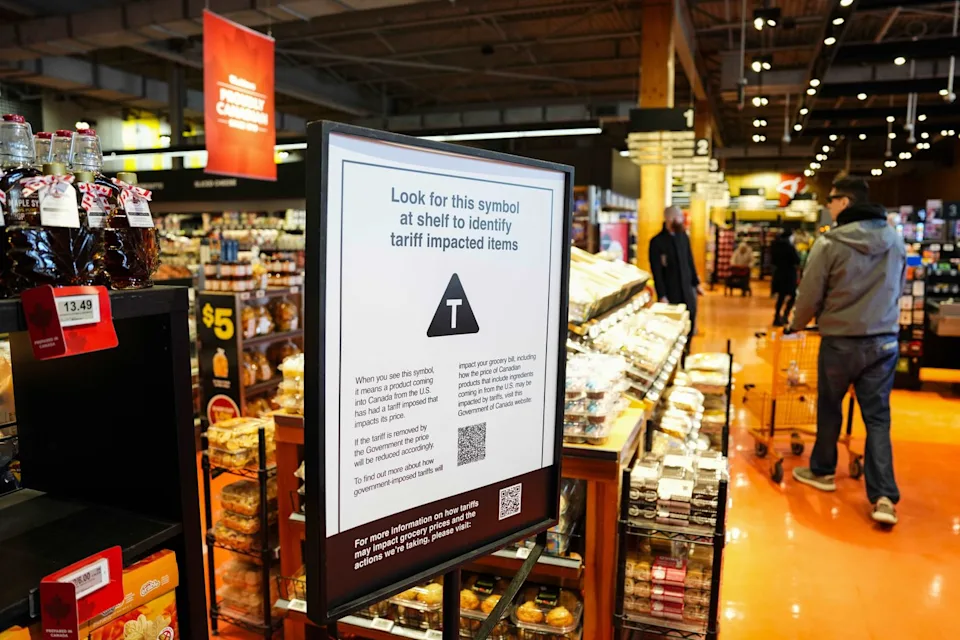
- Retailers used “Tariff banners” in-store — explicitly labeling price increases as tariff-related, shifting customer anger toward the US government rather than the retailer.
- Prices largely returned to normal within three months after Ottawa removed the counter-tariffs in September 2025.
- Domestic substitutes and non-US imports showed no significant price increases — validating the targeted, bilateral nature of the impact.
- Canada’s counter-tariffs remain on steel, aluminum, and autos that don’t comply with CUSMA.
For months in 2025, Canadian shoppers noticed something unusual on store shelves: little banners explaining why the price of American orange juice, ketchup, and appliances had suddenly jumped. Now, the Bank of Canada has put a hard number on what those banners actually cost.
Analysts at the Bank of Canada estimate prices on goods affected by Ottawa’s counter-tariffs against the United States last year were roughly six per cent higher on average than non-tariffed goods. The federal government imposed tariffs of 25 per cent on a variety of grocery items, clothing and other household staples coming from the United States for about six months starting in March 2025 in retaliation to US President Donald Trump’s initial tariffs.
The Study — 100,000 Products, Seven Retailers
Researchers at the Bank of Canada released a report Monday comparing the costs of more than 100,000 tariffed goods at seven retailers to a control group of products unaffected by duties. The analysis estimates nearly a quarter of Ottawa’s counter-tariffs were passed on to prices paid by consumers by mid-June 2025. This roughly matched the pass-through observed in the United States from Trump’s global tariffs during the same period, the analysts noted.
The parallel with the US is striking: whether it’s Washington or Ottawa imposing tariffs, consumers on both sides of the border ended up paying roughly the same fraction of the cost — about one in every four dollars of tariff burden.

The “Tariff Banner” Strategy — Retailers’ Clever Deflection
The tariff banners helped shift the burden of price increases off the retailer itself, the Bank of Canada analysts said. “This reduces the risk of customer backlash and gives retailers more room to pass through cost increases, which is what appears to have occurred in 2025,” the report read.
It was a masterstroke of retail psychology. Instead of absorbing the cost or quietly raising prices, Canadian retailers labeled American products with visible tariff notices — turning the price hike into a political statement and redirecting consumer frustration toward Washington rather than the store.
Liberation Day’s Shadow — Fear Drove Early Price Spikes
The analysis found that retailers’ perceptions of how long the trade dispute would last affected the pace at which they hiked prices. For instance, one appliance retailer in the study saw prices spike in the days after April 2, 2025 — “Liberation Day” in the United States when Trump ratcheted up his global tariff campaign — despite the fact that Canada’s counter-tariffs had been in place for a month by that time.
The Liberation Day effect reveals something important: it wasn’t just the tariffs themselves that raised prices. It was the fear that the trade war would escalate indefinitely — a fear that retailers priced into their goods even before they had to.
The Recovery — Prices Returned After Tariff Removal
The report said the bulk of those higher prices on tariffed goods fell back in line with the control group three months after Ottawa removed most of the counter-tariffs in September. Substitutes for tariffed goods sourced domestically or imported from non-US markets meanwhile saw no significant price hikes compared with the control group over the same time.
The data confirms both the damage and its limits: tariffs on specific US goods raised prices sharply — but once removed, markets corrected relatively quickly, and Canadian and non-US alternatives never experienced significant contagion.
Where Things Stand Now — Tariffs That Remain
Most Canadian goods are still able to enter the United States tariff-free thanks to the Canada-US-Mexico agreement on trade. US tariffs on steel, aluminum, autos and other key industries remain in place. Canada continues to levy counter-tariffs on select steel, aluminum and US-made autos that don’t comply with CUSMA, and imposes tariffs on global steel imports above certain quotas.
Prime Minister Carney’s gas-tax holiday and ongoing cost-of-living focus are direct responses to the inflation scarring caused by the 2025 tariff war — and this Bank of Canada report is the first definitive, data-driven confirmation of exactly how much that scarring cost Canadian families at the checkout line.
The trade war may be partially over. But the 6% price hike it left behind is a permanent reminder that tariff battles are never free — and that consumers, on both sides of every border, always end up paying the bill.
Disclaimer: This article is for general informational and educational purposes only. All statistics, findings, and quotes are sourced directly from the Bank of Canada’s research report as published by The Canadian Press on May 11, 2026, and covered by BNN Bloomberg, Yahoo Finance Canada, Narcity, Chronicle Journal, and 980 CJME. TrenBuzz.com does not provide financial or economic advice. Readers are encouraged to consult credible economic and government sources for the latest updates on Canadian and US tariff policy.