Published by TrenBuzz.com | May 21, 2026 | BREAKING
Key Points at a Glance – Five Gulf Nations Issue Unprecedented Warning
- Bahrain, Kuwait, Qatar, Saudi Arabia, and the UAE formally rejected Iran’s self-declared Persian Gulf Strait Authority (PGSA) on May 21, 2026.
- The five nations sent a letter to the International Maritime Organization (IMO) — telling ships NOT to engage with the PGSA or follow Iran’s designated route.
- Iran created the PGSA in late April — demanding ships pay tolls, follow designated lanes, and coordinate with Iranian authorities to transit the strait.
- The letter marks the first coordinated, legal rejection of Iran’s Hormuz authority by all five major Gulf states simultaneously.
- Shipping traffic through the Strait of Hormuz stands at just 5% of pre-war levels — down from ~3,000 ships per month before February 28.
- At least 17 merchant ships have been damaged, 2 captured, 12 seafarers killed or missing, and 1 tugboat sunk since the crisis began.
- Saudi Arabia and UAE can bypass Hormuz via overland pipelines — but Kuwait, Bahrain, and Qatar have no alternative export routes.
- China and Russia vetoed a UN Security Council resolution on Hormuz on April 7 — blocking international intervention.
- The IMO has declared a maritime security emergency — but has no enforcement mechanism without Security Council backing.
- Global oil prices responded: Brent rose 1.8% to $106.40 on the news.
For 83 days, five Arab nations have watched Iran attempt to turn an international waterway into a national toll road. On Thursday, they formally said no — in writing, to the world’s highest maritime authority.
Five Middle Eastern countries have formally rejected Iran’s establishment of the Persian Gulf Strait Authority to control transit through the Strait of Hormuz. In a letter to a global shipping watchdog, Bahrain, Kuwait, Qatar, Saudi Arabia and the United Arab Emirates said commercial and merchant vessels shouldn’t engage with the PGSA or cross the waterway using a route designated by Iran. The letter was issued earlier this week and distributed by the International Maritime Organization.
What Is the Persian Gulf Strait Authority — And Why It’s Illegal
Iran announced the creation of the PGSA in late April — claiming the right to manage, direct, and charge tolls on shipping transiting the Strait of Hormuz, with Iranian naval vessels empowered to board or redirect non-compliant ships.
Vessels in the Gulf reported receiving messages warning that no ships were allowed to pass the Strait of Hormuz without Iran’s permission. An official from the European Union’s naval mission Aspides said vessels operating in the Gulf have been receiving VHF radio messages from Iran’s Revolutionary Guards stating that “no ship is allowed to pass the Strait of Hormuz.”
The Gulf states’ IMO letter argues the PGSA has no basis in international law — the Strait of Hormuz is classified under UNCLOS as an international transit passage — and that Iran’s designation of specific shipping lanes violates every sovereign maritime nation’s right to navigate freely.
The Human and Economic Toll — 83 Days of Closure
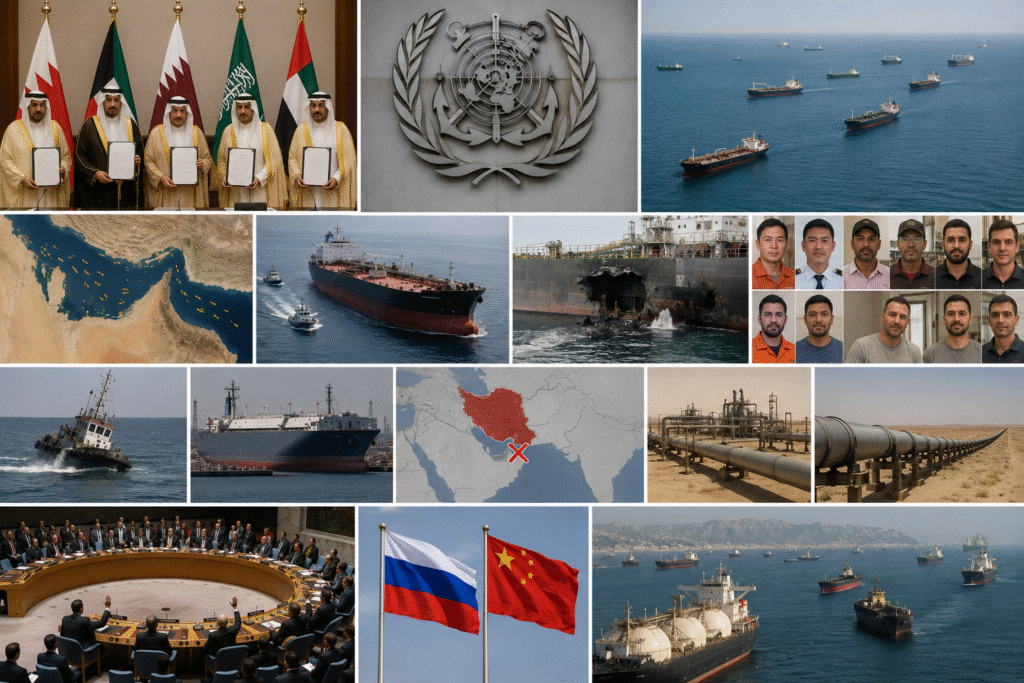
Shipping traffic through the Strait of Hormuz, a major maritime chokepoint for world energy trade, has been largely blocked by Iran since February 28, 2026. At least 17 merchant ships have been damaged, of which 7 were abandoned, 2 merchant ships were captured, 12 seafarers were killed or missing, and 1 tugboat was sunk. Pre-conflict, around 3,000 vessels used the strait each month. Their numbers now stand at around 5% of this level.
Several Arab states were forced to cut or suspend oil production due to Iranian attacks. While Saudi Arabia and the UAE have pipelines to bypass the narrow waterway and allow some exports, other Gulf nations such as Kuwait, Qatar, and Bahrain have no alternative export routes — meaning the Strait’s closure directly cuts their revenues.
The UN Dead End — Veto and No Enforcement
On April 7, China and Russia vetoed a draft UN Security Council resolution on the Strait of Hormuz. The Bahraini-drafted resolution had called for an end to Iranian attacks and for states to “coordinate efforts” defensively for shipping access, including escorts for ships. The UK, US, and Gulf states all backed the resolution.
Without Security Council backing, the IMO letter — however legally sound — carries no enforcement mechanism. The Gulf states know this. Their move is diplomatic, not operational — designed to build a global legal and moral framework before a multinational naval mission eventually forces the issue.
What Comes Next — The Multinational Mission Takes Shape
Gulf states are pushing a United Nations Security Council resolution that threatens Iran with sanctions and other measures if it does not halt attacks on ships, stop imposing “illegal tolls,” and disclose the location of all mines to allow freedom of navigation.
There are also defensive UK and other multinational initiatives under discussion to reopen the strait to vessels — including the UK’s HMS Dragon, Typhoon jets, and mine-hunting drone deployment announced May 12.
The Gulf letter to the IMO is the legal foundation stone of that multinational mission. The ships will come when the conditions allow — but when they do, this IMO letter will be the document that tells every maritime court in the world exactly which side stood with international law, and which side tried to own an ocean.
Disclaimer: This article is for general informational and news reporting purposes only. All shipping figures, IMO letter details, and casualty numbers are sourced from Bloomberg, Al Jazeera, Wikipedia’s 2026 Strait of Hormuz Crisis article, the House of Commons Library, and NPR as of May 21, 2026. TrenBuzz.com does not represent any government, maritime authority, or shipping company. Readers are encouraged to follow official IMO communications and credible international news sources for the latest maritime security updates.