
Key points
- The U.S. is reinforcing the Middle East with more ships, airpower, and troops, including the 82nd Airborne and about 5,000 Marines.
- AP says any attempt to secure Iran’s enriched uranium stockpile by force would be “extremely risky, complex, and prolonged.”
- Iran is still able to strike back, with AP reporting about 30 attacks a day and a substantial share still getting through defenses.
- Trump says the U.S. could end the campaign in two to three weeks, which suggests Washington is still weighing a shorter path rather than a long ground war.
- Public opinion is leaning sharply against ground troops, with one recent poll showing only 14% support.
The phrase US weighs Iran ground operation has become the shorthand for a bigger question: how far Washington is willing to go before Iran strike risks become too costly to manage. U.S. reporting shows a rapid military buildup, but also clear signs that the White House still wants an exit ramp.
Why this story is moving so fast
The latest reporting shows an American posture that looks prepared for escalation but not locked into it. Reuters said the White House believes U.S. forces are ready to thwart further Iranian attacks after the IRGC threatened American firms, while AP reported major reinforcement moves into the region.
That is why the words General assess Iran strike risks are appearing everywhere. Military planners are not only evaluating targets; they are judging whether the next step would turn a limited campaign into a prolonged ground fight.
What the ground-operation talk really means
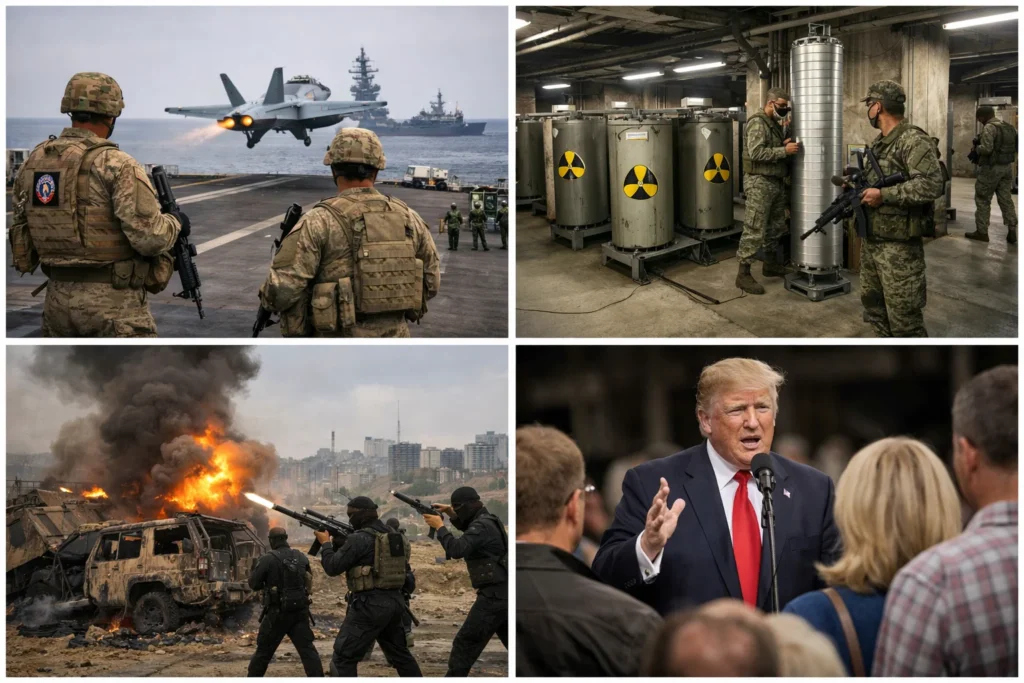
A full ground operation would not simply mean more troops on the map. It would raise the stakes around nuclear material, logistics, radiation protection, extraction routes, and force protection, all while Iran continues to operate in a dispersed and hardened environment. AP says that kind of mission would be “extremely risky, complex, and prolonged.”
AP’s reporting also notes that Iran’s enriched uranium is likely stored in heavily protected sites such as Isfahan, Natanz, and Fordo, some of them underground. That is one reason a ground operation is being treated as a last-resort option rather than a normal military move.
The battlefield is not one-sided
Despite heavy U.S.-Israeli pressure, AP says Iran is still landing roughly 30 strikes a day and breaching defenses in a meaningful share of attacks. That matters because it means Iran is not acting like a collapsing force; it is acting like a force trying to preserve leverage.
Reuters added that the U.S. and its allies are now on high alert after direct threats to American interests. In practical terms, Iran strike risks include retaliation against bases, shipping, energy assets, and U.S.-linked companies across the region.
Why Trump’s timeline matters
Trump’s statement that the U.S. could end the war in two to three weeks is a major clue. It suggests the administration is publicly signaling speed, not occupation, even as it shifts forces into the theater.
That is why analysts are reading the move as a pressure campaign with an exit strategy built in. This is an inference from the troop surge plus the short-war language, not a formal Pentagon plan that has been publicly released.
What generals are likely assessing
Based on the reporting, generals are likely measuring five things at once: whether Iran’s retaliation can be contained, whether U.S. bases remain secure, whether maritime routes stay open, whether regional partners will support the effort, and whether any ground mission can end quickly. Those are the practical questions behind the phrase Iran strike risks.
The hardest problem is not firepower. It is whether the U.S. can achieve a military objective without getting trapped in a mission that expands faster than the policy decision behind it. AP’s description of a force-based uranium seizure captures exactly that danger.
Public opinion is pushing the other way
A Washington Post poll published today says Americans overwhelmingly oppose sending ground troops to Iran. Only 14% supported that move, while 62% opposed it, and even many Trump voters were reluctant to back a ground war.
That public mood is important because it shapes how long a military campaign can stay politically viable. A limited strike may be sold as deterrence, but a ground operation would face much steeper resistance at home.
Bottom line
The current picture is not a confirmed ground invasion, but it is more serious than routine saber-rattling. The U.S. is building force, Iran is still striking back, and the political appetite for a ground war is weak. That is the center of the Iran strike risks debate now.
Trenbuzz Disclaimer: This article reflects public reporting available as of April 1, 2026. Military and diplomatic conditions may change quickly, and no public report has confirmed a final U.S. ground-operation decision.