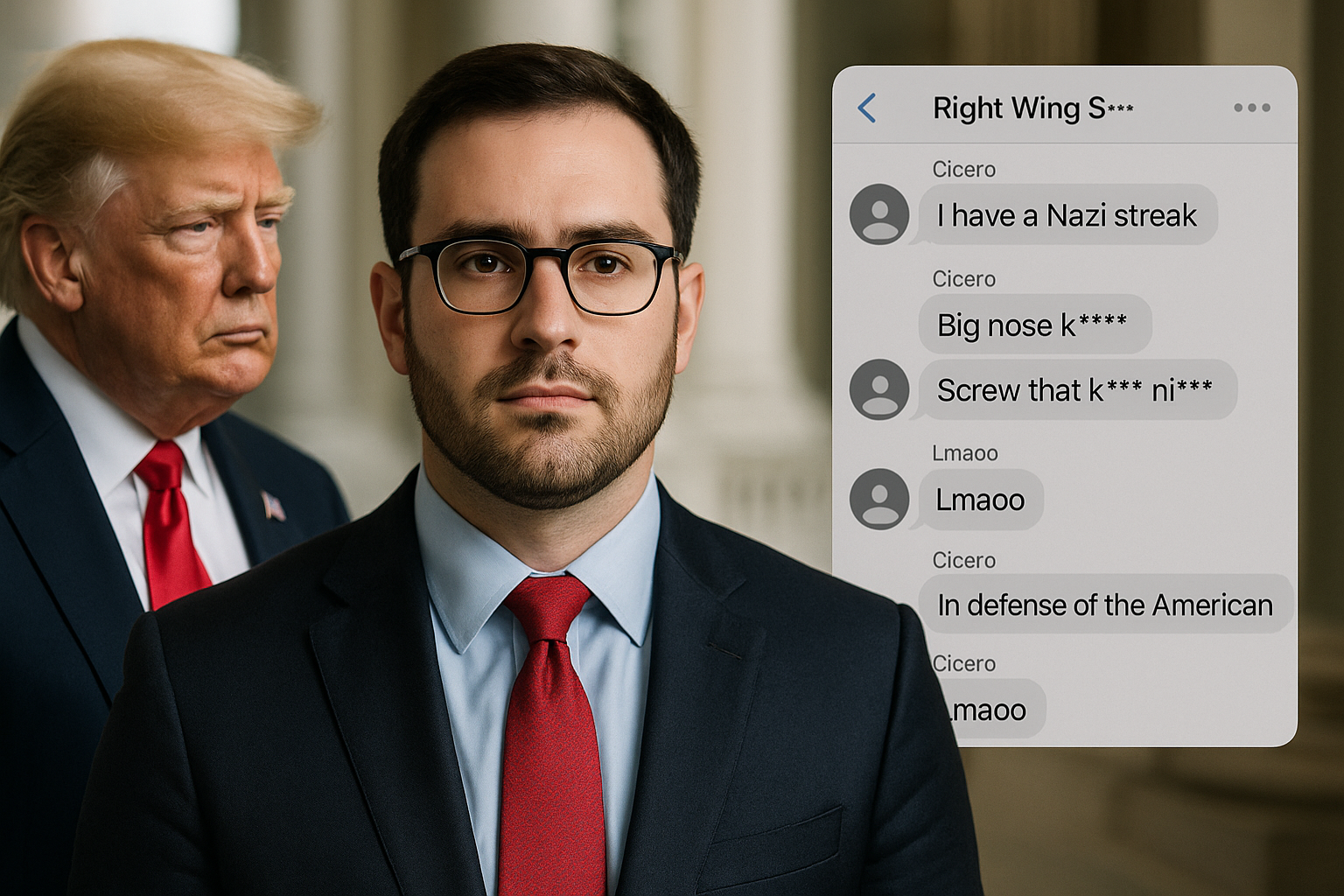
Paul Ingrassia Texts: President Trump’s nominee for the U.S. Office of Special Counsel, Paul Ingrassia, is facing a growing confirmation crisis after Politico published texts from a private Republican group chat in which Ingrassia allegedly wrote racist, antisemitic and pro-Nazi-adjacent lines — including the phrase that he “has a Nazi streak.” The disclosures have prompted bipartisan alarm, calls from Senate Republicans for the White House to withdraw the nomination, and denials from Ingrassia’s lawyer that the messages are anything more than satire or manipulated images. This post explains the background, what the texts reportedly say, who has reacted (including senators and unions), how nomination processes work, and where to watch for verified updates.
1) Who is Paul Ingrassia — a quick bio
Paul J. Ingrassia (born 1995) is an attorney who served as a White House liaison to the Department of Justice and later to the Department of Homeland Security.
He graduated from Cornell Law School (2022) and built a profile as a conservative commentator with a Substack read by figures in the Trump orbit. He was nominated in May 2025 to lead the Office of Special Counsel (OSC), the agency charged with protecting federal whistleblowers and enforcing certain civil-service rules.
2) What the Paul Ingrassia texts reportedly contain
Politico reported a set of private group-chat messages attributed to Ingrassia in which he wrote that Martin Luther King Jr. “was the 1960s George Floyd” and that MLK Day should be “tossed into the seventh circle of hell.”
The messages also allegedly included slurs, the line “Never trust a chinaman or Indian” (directed at Vivek Ramaswamy), calls to “eviscerate” Black-related holidays, praise for “competent white men,” and — when another participant compared him to Hitler Youth — Ingrassia’s reply: “I do have a Nazi streak in me from time to time, I will admit it.” Those excerpts are what propelled the current outcry.
3) How the story spread and who corroborated it
The Politico piece was picked up and corroborated in summary by Reuters, The Guardian, People, Newsweek and other outlets; wire services framed the texts as part of a broader cache of messages from a Young Republicans Telegram group that had already drawn scrutiny.
Multiple journalists and outlets reported that Politico verified the messages with multiple participants in the chat — the usual practice for a scoop of this sort — though Ingrassia’s counsel has disputed the context and authenticity.
4) Ingrassia’s legal team response — “satire” or manipulated images
Ingrassia’s attorney, Edward Paltzik, told reporters some portions of the reporting could be manipulated and argued the messages were “satirical” or intended to lampoon how critics label MAGA figures “Nazis.”
That defense has not stopped Senate leaders and public-sector unions from demanding the White House withdraw the nomination; several Republican senators publicly said they would not vote to confirm him after the latest revelations.
5) Why this matters — the job, the optics, and public trust
The Office of Special Counsel is charged with protecting whistleblowers and enforcing federal ethics in certain areas — a role that requires perceived impartiality and a commitment to civil-service protections.
A nominee accused of racist or extremist rhetoric raises immediate questions about fitness for that office, and the optics quickly translate into political pressure in the Senate confirmation process. That’s why the story has moved rapidly from a private chat to a question about the nomination’s viability.
6) Which Republican senators publicly moved away from Ingrassia
Senate Majority Leader John Thune said he hoped the White House would withdraw the nomination and indicated Ingrassia “is not gonna pass.” Senators Rick Scott, Ron Johnson and James Lankford were among others who signaled they would oppose confirmation.
With those defections, the White House would struggle to secure the GOP votes necessary to win confirmation without losing others — a key reason the nomination appears in serious jeopardy.
7) Past controversies and the build-up to this moment
Ingrassia’s nomination had already attracted criticism for his relative inexperience, prior writings, and reported past associations with far-right figures (reporters have singled out social connections such as Nick Fuentes and past comments praising certain “dissident” voices).
He was previously the subject of other reporting — including claims of workplace misconduct and criticism of federal employees — that caused a July committee hearing to be postponed. The newly reported texts intensified that scrutiny.
8) Legal and procedural fallout — what the Senate does next
If the White House withdraws the nomination, the process ends unless the president re-submits the name. If the White House keeps Ingrassia on the ballot, the Senate Judiciary or Homeland Committee would still hold a confirmation hearing, and the full Senate would vote only if the committee advances the nomination.
Given public statements from key Republican senators, the practical path forward for Ingrassia looks narrow unless he convinces undecided senators or the White House withdraws him and names another candidate.

9) The role of Politico and the Young Republicans cache
This episode is part of a larger set of leaked Telegram chats and messages involving Young Republican leaders that Politico and others previously reported exposed racist, antisemitic and violent rhetoric across a network of young GOP operatives.
That prior reporting created a context in which subsequent, more personal texts by a White House-linked nominee become especially damaging — because they feed into a pattern that journalists and lawmakers already flagged.
10) What good-government and labor groups say
More than 20 federal employee unions and government watchdog groups previously urged the Senate to reject Ingrassia, citing his prior comments describing federal workers as “parasites,” and calling attention to his lack of experience.
After the recent text revelations, those groups intensified their calls for a withdrawal, arguing the OSC requires someone committed to fair enforcement and public-service integrity. Expect statements and possible legal-filed opposition to be cited at hearings if the nomination proceeds.
11) How to read the claims responsibly — a short guide for readers
- Primary source: Politico’s reporting is the immediate source of the text excerpts; Reuters and other wire services corroborated the story.
- Presumption of context: Private-chat material can be sarcastic, satirical or manipulated — that’s why lawyers claim context matters; still, multiple participants and corroboration reduce the likelihood of wholesale fabrication.
- Wait for verification: The authoritative facts that matter for formal consequences are (a) the nomination record, (b) any official authentication by investigators or a party, and (c) congressional statements or committee memos. Until then, report responsibly and avoid amplifying unverified additions.
12) Where to watch this story unfold — verified sources
For real-time updates and primary documents, check: Politico (original scoop), Reuters (wire confirmation), The Guardian, People, and official Senate statements from leaders like John Thune. Also monitor the White House press office and Ingrassia’s legal counsel’s public filings for procedural updates.
Final takeaway — what matters most for citizens and readers
The Paul Ingrassia texts story is about more than one nominee’s private messages: it raises questions about vetting, the kinds of advisors a president chooses for watchdog roles, and how private rhetoric intersects with public office suitability.
At the moment (Oct 21, 2025) the major published facts are: (1) Politico published the texts and excerpts; (2) Reuters, The Guardian and others reported on the revelations; (3) Ingrassia’s attorney claimed satire/manipulation; and (4) key Republican senators say they will oppose the nomination — putting it effectively on ice. Follow the verified sources linked below for primary documents and formal statements.
Sources — verified links
These are the primary, authoritative public sources used to compile the article. Each was live and accurate at the time of writing:
- Politico — original reporting on Paul Ingrassia’s text messages (see Politico’s coverage by Daniel Lippman). (Democracy Now!)
https://www.politico.com/news/2025/10/20/paul-ingrassia-racist-text-messages-nazi-00613608 - Reuters — “Trump pick for whistleblower office texted he has ‘Nazi streak,’ Politico reports.” (Reuters)
https://www.reuters.com/world/us/trump-pick-whistleblower-office-texted-he-has-nazi-streak-politico-reports-2025-10-20/ - The Guardian — “Trump nominee reportedly boasted of ‘Nazi streak’ in group chats.” (The Guardian)
https://www.theguardian.com/us-news/2025/oct/20/trump-nominee-paul-ingrassia-group-chats - People — “Leaked Texts Claim Trump Nominee Said He Has a ‘Nazi Streak’ Days Before Confirmation.” (People.com)
https://people.com/leaked-texts-claim-trump-nominee-said-he-has-nazi-streak-days-before-confirmation-11833504 - Newsweek — coverage and context about the texts and senator reactions. (Newsweek)
https://www.newsweek.com/paul-ingrassia-trump-racist-text-messages-nazi-politico-10909695 - Just Security / background context on related developments in the Young Republicans chats. (Just Security)
https://www.justsecurity.org/122879/early-edition-october-21-2025/
Disclaimer : This article summarizes reporting from reputable outlets and public statements as of October 21, 2025. It presents reported material and parties’ rebuttals; it does not assert guilt or criminality. For primary documents and the latest developments on the nomination, consult the links above and official Senate statements.