
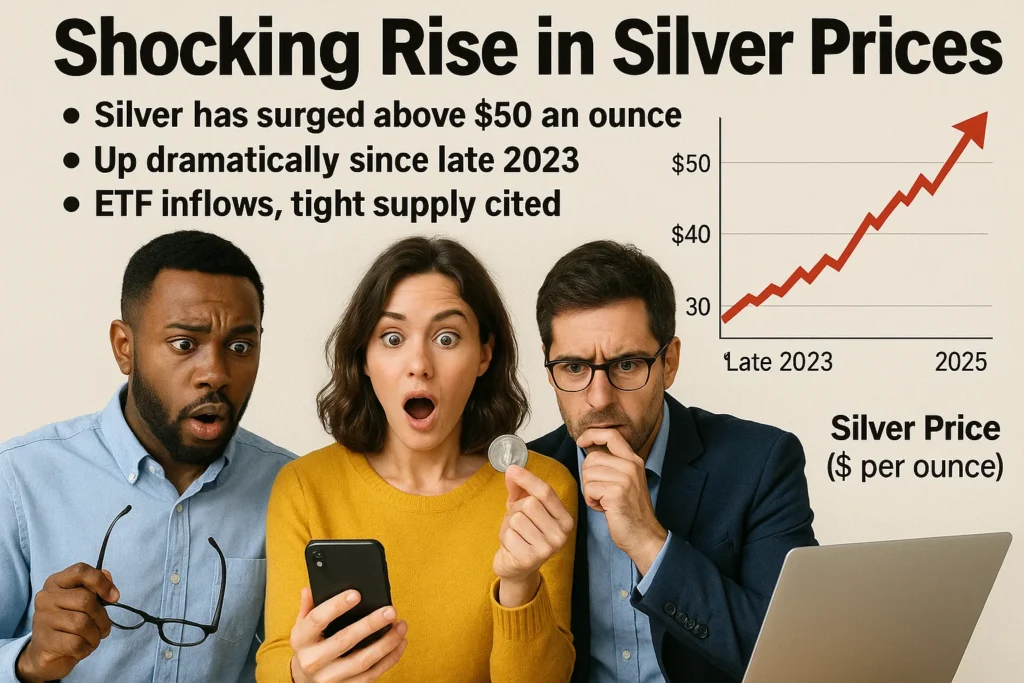
Silver has staged a dramatic run in 2025, climbing from roughly $20 an ounce in late 2023 to above $50 today.
This “shocking rise in silver prices” has caught global investors, manufacturers, and policymakers off guard.
This article breaks down the why, the how, and the what-next in clear steps.
Read through the timeline, key drivers, market impacts, and practical takeaways for everyday investors.
The headline numbers — quick snapshot
Spot silver traded near $53–54 per troy ounce in late November 2025, up dramatically year-to-date.
Trading and futures services show silver up more than 70–160% from two years earlier during the rally.
ETF inflows, industrial demand, and tight physical supply have together produced this sharp gain.
Market participants describe the move as both cyclical and structural — not a simple short-term blip.
How the rally unfolded — step-by-step timeline
- From late 2023 through 2024, investor interest in precious metals increased as inflation and macro uncertainty rose.
- In 2025, clearer signs of falling real yields and market expectations of U.S. rate cuts accelerated fund buying.
- Surging industrial demand — especially for solar panel production and electronics — tightened physical markets further.
Each step compounded the next: investor buying lifted prices, which attracted more inflows, which in turn squeezed physical availability.
That feedback loop has been a major reason the rise looks “shocking” to many observers.
Five fundamentals pushing silver higher today
- Industrial demand boom. Rapid growth in solar and electronics has raised silver consumption materially.
Solar-sector demand alone accounts for a fast-growing share of total annual silver use. - Inflation and rate-cut expectations. Investors flock to non-yielding assets when real yields fall and rate cuts are expected.
Dovish Fed signals in late 2025 have been supportive for precious metals. - ETF and investor flows. Physically-backed silver ETFs recorded strong net inflows, tightening backing stocks and increasing price pressure.
When ETFs buy metal for custody, it removes supply from the physical market and amplifies upward moves. - Supply constraints. Silver is largely a byproduct of base-metal mining, limiting how fast new supply can respond to rising prices.
Long lead times and falling mine grades have made the market more sensitive to demand shocks. - Regional buying and premiums. Festivals, industrial buying seasons, and import patterns in places like India pushed local premiums and added momentum.
Local surges sometimes force physical dealers and exchanges to reprice rapidly.
Market impacts — who feels it first
- Investors: Paper and ETF holders have seen big gains, but volatility is high and corrections are possible.
- Manufacturers: Higher input costs for electronics and green-tech manufacturers could affect margins and pricing.
- Jewelry & retail: Spot price jumps ripple into retail bullion and jewelry markets, sometimes causing local shortages.
- Miners & metals stocks: Producers and byproduct miners often see stock gains; downstream suppliers may feel cost pressure.
Risks and warning signs to watch
Rapid rallies can reverse quickly if macro sentiment shifts or if rate-cut expectations are delayed.
Key risk indicators include rising real yields, a strengthening US dollar, or large ETF outflows.
Supply-side relief is slow; new mining capacity takes years and rarely reacts to a single seasonal spike.
That structural rigidity increases the chance of sustained volatility even if the long-term trend moderates.
Practical guidance for readers (plain and pragmatic)
- Treat the rally as high-volatility: position sizes should match risk tolerance.
- If buying physical metal, check premiums and delivery times — short supply can raise costs.
- For investors who prefer paper exposure, compare ETF custody practices, fees, and redemption terms.
Never use margin or leverage unless fully prepared for steep drawdowns; silver can move both ways fast.
Consider diversifying exposure across metals or using small, staged buys to reduce timing risk.
What to expect next — scenarios
• Bull continuation: Further weakness in the dollar and continued industrial demand could push silver to new highs.
• Correction: A sudden shift in Fed guidance or profit-taking by large holders could trigger a sizeable pullback.
• Sideways consolidation: The market may oscillate as investors assess industrial demand versus available supply.
Do you think the recent shocking rise in silver prices will continue into 2026?
Final take
The shocking rise in silver prices reflects a rare mix of investor flows, industrial demand and tight physical supply.
For cautious investors, the move is an opportunity — but one that requires careful sizing, research, and an eye on macro signals.
Disclaimer: This article is for informational purposes only and does not constitute financial, tax, or investment advice.
Readers should consult a licensed financial advisor before making investment decisions and verify quotes and prices with official market sources.