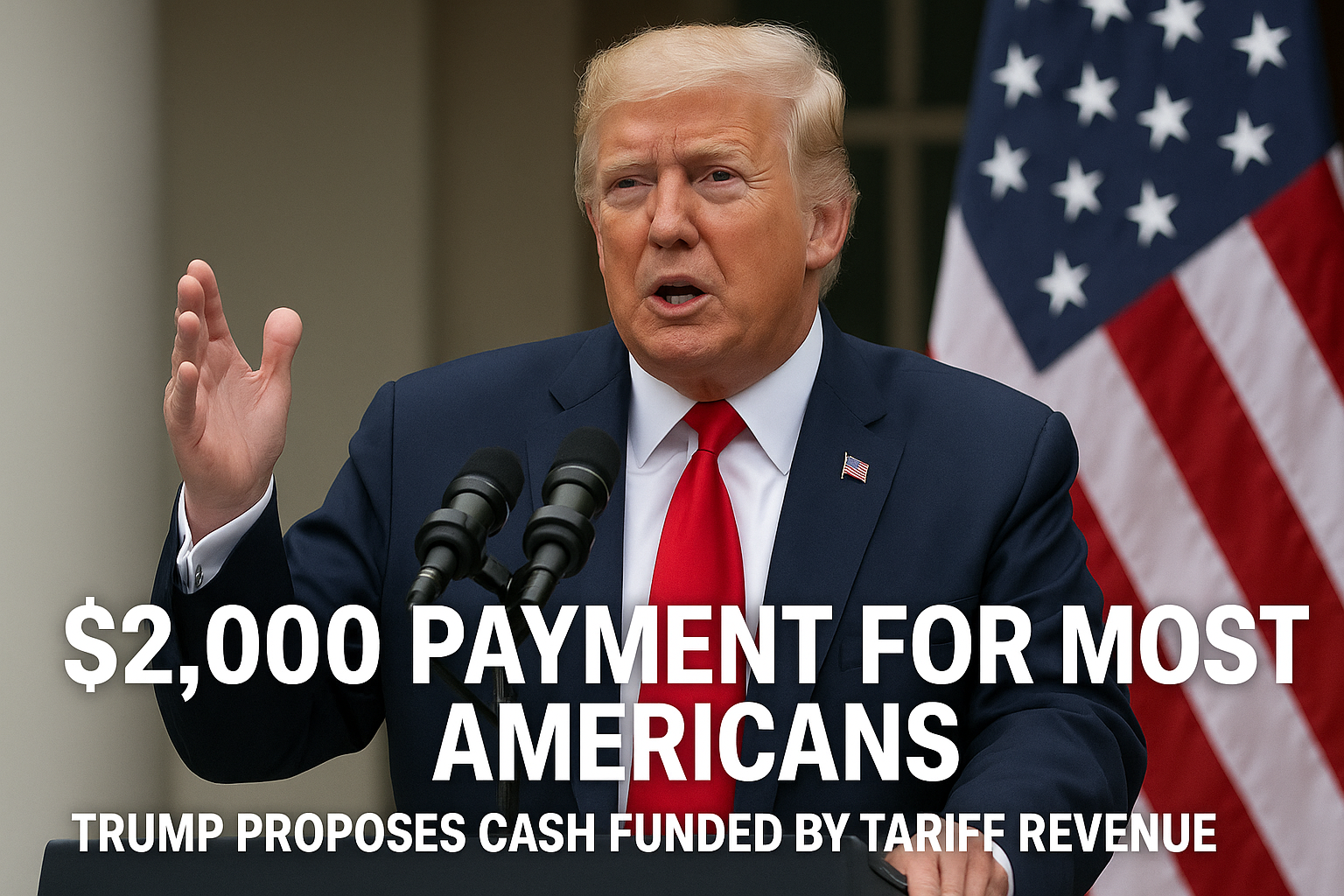
Tariff Dividend Checks: This TrenBuzz explainer breaks down the renewed headlines about a “tariff dividend” — President Trump’s Sunday announcement proposing $2,000 per person paid out of tariff revenue — and walks readers step-by-step through the policy mechanics, the legal and fiscal hurdles, who might qualify, likely timelines, scams to avoid, and what to watch next.
Tariff Dividend Checks — what Trump just said (one line)
On Sunday the President posted that a tariff dividend of at least $2,000 per person would be paid to most Americans from tariff revenue, excluding high-income earners.
1 — What is a “tariff dividend”
A tariff dividend is a proposal to take some or all government revenue raised by import taxes (tariffs) and return a portion of it directly to households as a cash payment.
It’s similar in spirit to proposals in some countries to rebate resource rents to citizens, or to previous U.S. “stimulus” or rebate checks — but financed specifically from tariff receipts.
2 — The immediate story: where the $2,000 figure came from
President Trump announced the $2,000 figure in a Truth Social post and follow-up messages describing tariff revenue as “trillions” and saying most Americans (except high earners) should receive payments.
News organizations picked up the post quickly; coverage emphasizes that the announcement gave a headline amount but not implementation details such as timing, eligibility rules, or the paperwork involved.
3 — Tariff revenue: is there enough cash to fund $2,000 checks?
Tariff revenue has surged since the administration’s broader tariff program, but published figures vary and do not automatically equal a multi-hundred-billion-dollar permanent pot.
Some outlets reported recent tariff receipts in the low-to-mid-hundreds of billions for recent intervals, while others cite different accounting windows; Treasury and independent budget groups have published differing snapshots. That variability matters because a universal $2,000 payment multiplied by hundreds of millions of people quickly reaches into the many-hundreds-of-billions or trillions.
4 — Simple math (why a broad $2,000 payment is expensive)
A rough calculation shows why policy details matter. $2,000 multiplied by 250 million adults equals $500 billion.
Even if the government limited payments to, say, 150–200 million eligible recipients or excluded high earners, the total dollar bill remains very large — which is why reporters and budget analysts are asking where the money would come from and whether those tariff totals are a sustainable funding source.

5 — Legal and institutional roadblocks — it’s not automatic
A major near-term obstacle is legal: courts are already reviewing the administration’s sweeping tariff authority under emergency statutes, and several lower courts have previously ruled many of the levies unlawful.
If the tariff program is curtailed or curtailed in scope by the courts, the pool of revenue that could fund a dividend would shrink or become legally disputed — and Congress, not the White House alone, traditionally controls appropriation and large-scale fiscal policy.
6 — Who decides how to distribute a tariff check?
There are several models for distribution — direct IRS-style deposits tied to Social Security numbers, a targeted means-tested rebate, or a universal per-person payout.
Each approach has practical consequences: an IRS deposit model leverages existing tax records but requires Treasury implementation and administrative rules; a targeted approach reduces fiscal cost but needs eligibility screens; and universal payments are fastest but most expensive. The announcement so far did not specify the mechanism.
7 — The politics: why the President might push tariff checks now
Politically, a tariff dividend hits two goals often cited by proponents: (1) it reframes tariffs as a direct household benefit rather than a business cost; and (2) it creates a visible, popular payout that can build political support for the administration’s broader trade approach.
But many economists warn tariffs can raise downstream consumer prices; the net benefit of rebate checks depends on how much of the tariff cost is passed along to consumers versus captured as government revenue.
8 — Economic trade-offs: inflation, prices and distributional effects
Tariffs raise the cost of imports — that can be inflationary for goods whose supply is affected (autos, electronics, certain food items). If businesses pass those costs to consumers, a $2,000 rebate could be partly offset by higher prices.
The true distributional effect depends on which goods are targeted by tariffs and which households consume them most. Some lower-income households spend more of their income on goods, so the real-world impact of tariffs-plus-rebate is complex.

9 — Where the legal fight matters: the Supreme Court and timing
Courts are actively weighing whether the President can impose sweeping tariffs under emergency powers without explicit new congressional law. The Supreme Court recently heard arguments that directly affect the legal durability of those tariffs.
If the Court rules against broad executive authority, some tariffs could be undone (or limited), shrinking the projected revenue stream and complicating any plan to issue rebate checks. That’s one reason many budget analysts say large payments are unlikely before legal and congressional issues are resolved.
10 — How likely is a $2,000 payment this year? (realistic timeline)
Short answer: unlikely this week. An on-time mass distribution requires: (a) a clear appropriation or executive legal authority, (b) Treasury/IRS implementation details, and (c) operational readiness for millions of direct deposits or mailed checks.
Most independent reporting and budget analysts suggest that while the President can propose and publicize a tariff dividend, turning it into cash payments quickly — in the face of court challenges and missing implementation rules — is a separate and time-consuming task.
11 — Scams, misinformation and how to verify any “tariff check” news
Whenever speculation about a government check circulates, scams follow. Common fraudulent patterns: fake government emails/texts promising immediate payments, social posts with “sign up here” links that steal bank details, or copycat websites trying to harvest personal data.
Always verify with official Treasury or IRS announcements, and treat social posts claiming “your $2,000 is ready — click here” as suspicious. Legitimate federal rebate programs are announced via official channels and accompanied by clear eligibility and distribution procedures.
What this means for readers — a practical checklist
- Treat the $2,000 figure as a policy announcement, not a guaranteed payment date.
- Expect months, not days, between a headline and any actual deposit — if it happens.
- Watch how Congress, Treasury, and federal courts react — those institutions determine whether a dividend can be lawfully and practically delivered.
- Don’t click unknown links; verify via official government statements before sharing any “you’re eligible” notices.
How analysts are modeling different versions of a “tariff dividend”
Budget analysts build scenarios: a universal $2,000 check to all adults; a $2,000 check only to adults under a means threshold; or targeted credits for low-income households. Each scenario has different fiscal costs and political tradeoffs.
Independent fiscal groups will likely publish cost estimates within days; those projections determine whether proponents adjust the proposal (smaller per-person amounts, narrower eligibility) or press for broader payout ambitions.
FAQ — short answers readers keep asking
Q: Is this the same as a 2020-style stimulus?
A: Not exactly — both are cash payments, but a tariff dividend would be funded (supposedly) from tariff receipts rather than pandemic-era federal deficits and appropriations. The implementation mechanics can nonetheless be similar.
Q: When will I see my $2,000?
A: No date has been set; many reporters and budget experts say a legal and administrative pathway needs to be clear before payments could be scheduled.
Q: Who’s excluded?
A: The President’s statement said “not including high income people,” but no definition of “high income” was published in the announcement. Eligibility details are decisive and missing.
How TrenBuzz will follow this story (what we’ll track)
• Official White House / Treasury statements clarifying eligibility and timing.
• Congressional reaction and any appropriations or statutory bills introduced.
• Court rulings affecting tariff legality and the revenue baseline.
• Independent cost estimates from fiscal policy groups. We’ll update this post as those concrete items appear.
Responsible reporting checklist (for other publishers)
• Quote the original announcement platform (Truth Social) verbatim and label it as a political statement.
• Don’t treat the headline number as a distribution date; make clear when details are missing.
• Seek independent fiscal estimates before reporting that the plan is “fully paid for” by tariffs.
TrenBuzz disclaimer
This article summarizes current reporting and analysis about an announced tariff dividend proposal as of November 9, 2025. It is informational only and not an official government announcement, legal advice, or financial counseling. For official eligibility, timing, and payment details consult Treasury, IRS, or congressional documents as they are published.