Published by TrenBuzz.com | May 2, 2026
Key Points at a Glance – Trump Drops a 25% Auto Tariff Bomb on the EU
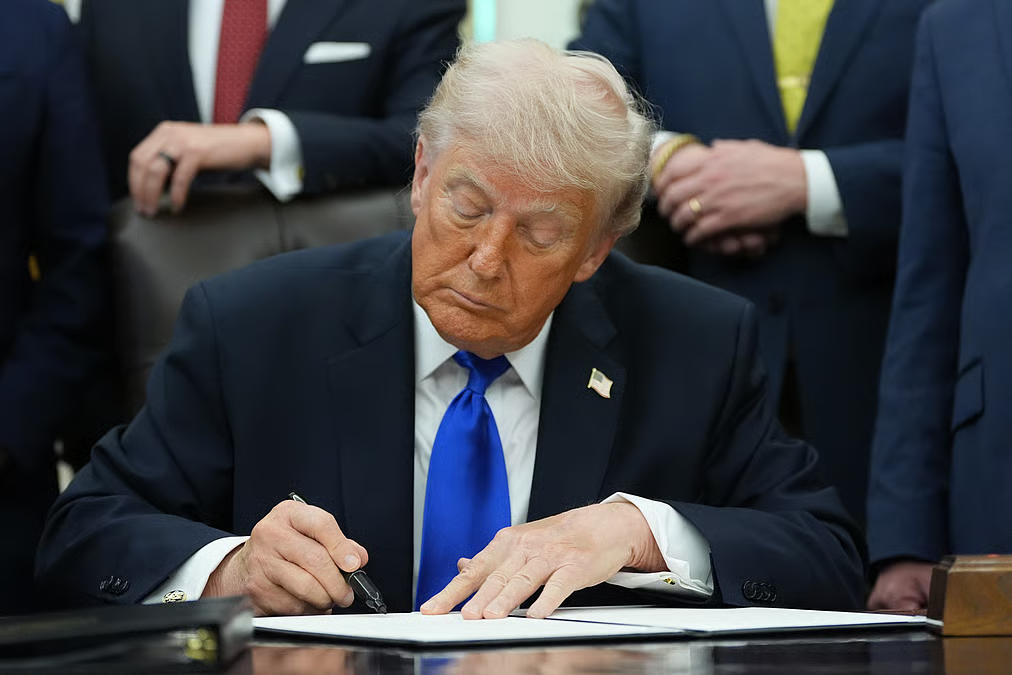
- President Trump announced on May 1, 2026 via Truth Social that he will raise tariffs on all cars and trucks from the EU to 25% — effective the following week.
- Trump accused the EU of “not complying” with a trade deal agreed upon with European Commission President Ursula von der Leyen in July 2025.
- The original deal set a 15% tariff on most goods — Trump’s new 25% auto tariff blows past that agreement.
- Trump invoked Section 232 authority — citing national security risks — to legally justify the increase after the Supreme Court struck down his broader IEEPA tariffs in February 2026.
- The EU responded firmly: “A deal is a deal” — pledging to keep options open to “protect EU interests.”
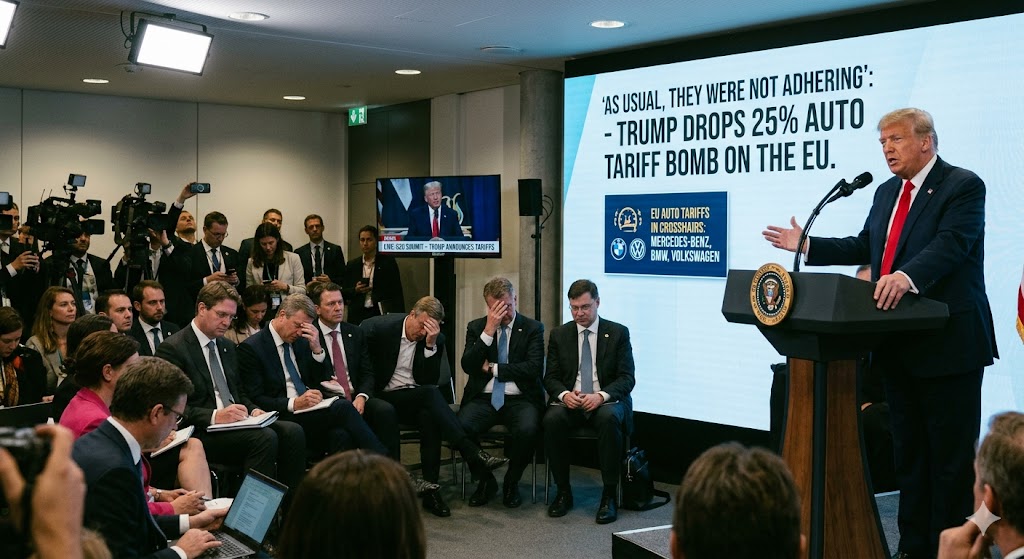
- Mercedes, BMW, and Volkswagen are the most exposed — all import significant volumes of vehicles from European plants.
- Trump offered an exemption: “If they produce Cars and Trucks in US Plants, there will be NO TARIFF.”
- The move comes as Trump also threatened to pull US troops from Germany, Italy, and Spain over their refusal to support the Iran war.
- EU automakers had expected the July 2025 deal to save them €500–600 million per month — that saving now evaporates.
- A May Day protest wave swept across the US on the same day Trump made the announcement.
On the last day of April — as King Charles sipped champagne in the Trump White House ballroom — Donald Trump was already planning his next economic salvo. It landed May 1, and it’s aimed squarely at Europe’s most prized industry.
“Based on the fact the European Union is not complying with our fully agreed to Trade Deal, next week I will be increasing Tariffs charged to the European Union for Cars and Trucks coming into the United States,” Trump wrote on Truth Social. “The Tariff will be increased to 25%. It is fully understood and agreed that, if they produce Cars and Trucks in U.S.A. Plants, there will be NO TARIFF.”
What Deal Did Trump Say the EU Broke?
Trump and European Commission President Ursula von der Leyen agreed to a trade deal at the Trump Turnberry golf course in July 2025, which set a 15% tariff on most goods. The EU had said it expected the bilateral deal would save European car manufacturers between €500–600 million a month.
The Supreme Court struck down Trump’s broader IEEPA “reciprocal” tariffs earlier this year. Shortly after, Trump signed an executive order imposing a new 10% “global tariff” rate, then raised it to 15%. The EU, seeing these new rates as a potential violation of the July deal, postponed its planned vote to ratify the agreement.
The EU’s delay in ratifying — which Brussels calls standard legislative procedure — is what Trump characterized as non-compliance. Europe sees it differently: the new US tariff structure changed the ground rules first.
What Legal Authority Is Trump Using?
While Trump did not specify what tariff authority he was invoking in his Truth Social post, it appears the administration will use Section 232, which authorizes him to adjust imports of goods that the Secretary of Commerce finds to have been imported in a manner that threatens US national security. The White House confirmed this, noting “the President reserves the right to adjust tariff rates if our trade deal partners fail to abide by their commitments.”
The Trump administration had broadly implemented 25% tariffs on vehicles and certain auto parts last year, citing national security risks under Section 232. Those levies remain in place — and the White House said Trump would increase the EU’s levies under the same authority.
Who Gets Hit Hardest — The German Auto Giants
The European automakers that could most be impacted by a change in tariff rate would be Mercedes, BMW, and Volkswagen, which import a large percentage of the vehicles they sell in the US from their plants in Europe.
Germany would be disproportionately hammered. In a particularly tense week for US-German relations, Trump also renewed criticism of German Chancellor Friedrich Merz on Thursday — telling him to focus on ending the Ukraine war instead of “interfering” on Iran.
Trump also referred to European allies Spain and Italy as “absolutely horrible” for their refusal to get involved in the Iran war — a diplomatic broadside that sets an even more combustible context for this latest tariff escalation.
The EU Fires Back — “A Deal Is a Deal”
The initial reaction from the EU’s end came from Bernd Lange, a lead MEP currently negotiating the implementation of the deal with EU member states. The European Commission said in February: “As the United States’ largest trading partner, the EU expects the US to honour its commitments set out in the Joint Statement, just as the EU stands by its commitments.”
A European Commission spokesperson added: “We maintain close contact with our counterparts, including as we also seek clarity on US commitments. We remain fully committed to a predictable, mutually beneficial transatlantic relationship. Should the US take measures inconsistent with the Joint Statement, we will keep our options open to protect EU interests.”
The Manufacturing Carrot — Build Here or Pay the Price
Trump said “many automobile and truck plants are currently under construction, with over $100 billion being invested,” adding: “These Plants, staffed with American Workers, will be opening soon.” The tariff is zero if you build on American soil — a pressure point that has already triggered factory announcements from Volkswagen, BMW, and Stellantis in recent months.
The EU-US trade relationship is worth €1.7 trillion annually — an average of €4.6 billion every single day. If Brussels retaliates with its own tariffs on American goods, that number could shrink dramatically — and consumers on both sides of the Atlantic will pay for every dollar of the difference.
Disclaimer: This article is for general informational and news reporting purposes only. All quotes, tariff details, and diplomatic facts referenced are based on publicly available and credible sources including CNBC, Bloomberg, Euronews, ABC News, and UPI as of May 2, 2026. The 25% EU auto tariff had not been formally implemented via Federal Register notice as of publication. TrenBuzz.com does not provide financial or investment advice. Readers are encouraged to follow official US Trade Representative and credible news sources for real-time updates.