
Key points
- Wall Street firms and major banks report a noticeable easing of regulatory pressure following President Trump’s recent executive order targeting so-called “de-banking” and broader agency rulemaking. Market participants say compliance touchpoints and supervisory interventions have declined in several areas.
- The executive order directs agencies to identify regulatory costs and to pare rules aggressively, shifting enforcement emphasis and accelerating deregulatory timelines already in motion. Legal advisers say agencies must still follow procedural safeguards, but the policy is reducing the pace and scope of new rules.
- The move is reshaping supervisory posture across finance and other regulated sectors: the Fed and other supervisors are trimming staff and signaling lighter-touch oversight, which Wall Street interprets as a lower compliance burden — with mixed implications for risk and competition.
- Markets have responded with cautious optimism: equities in regulated sectors have rallied on the prospect of lower costs, but analysts warn about longer-term trade-offs around financial stability, consumer protection and legal exposure.
Trump executive order — what happened and why readers should care
A presidential executive order issued in recent months aimed at reining in aggressive compliance pressure from federal regulators has translated, according to Wall Street sources, into materially lighter supervisory engagement for large banks, broker-dealers and some nonbank financial firms. Practically, that means fewer on-site exams, narrower informal enforcement requests and a faster rollback of recently proposed rules — developments that reduce near-term costs for regulated firms while raising questions about oversight, market resilience and consumer safeguards.
What the executive order does — the mechanics
The measure directs agency heads to inventory regulatory costs and prioritize rule repeal or modification where rules are judged to impose “undue burdens.” It also requires agencies to report cost-savings associated with new and repealed rules and to tighten internal review before issuing new obligations. That administrative architecture speeds deregulatory action without rewriting statutes — but it does not, by itself, remove statutory rulemaking requirements such as notice-and-comment.
Importantly, agencies retain legal duties: procedural safeguards (like notice-and-comment) and statutory mandates still constrain what rules can be changed and how quickly. Court challenges and congressional oversight remain potential brakes on rapid rollbacks.
How Wall Street is seeing the change
- Banks and compliance teams: Large financial firms report fewer ad-hoc inquiries from regulators, reduced scope in routine exams, and faster informal clearances on certain operational changes. Market commentary ties this to both the White House order and parallel staffing adjustments inside supervisory agencies.
- Deal flow and capital allocation: Reduced regulatory friction is already cited by some firms as a reason to accelerate M&A discussions and to re-deploy capital toward lending and trading businesses that previously faced heavy oversight. Analysts caution that while this can raise near-term profits, it can also increase systemic exposure if risk management loosens in response.
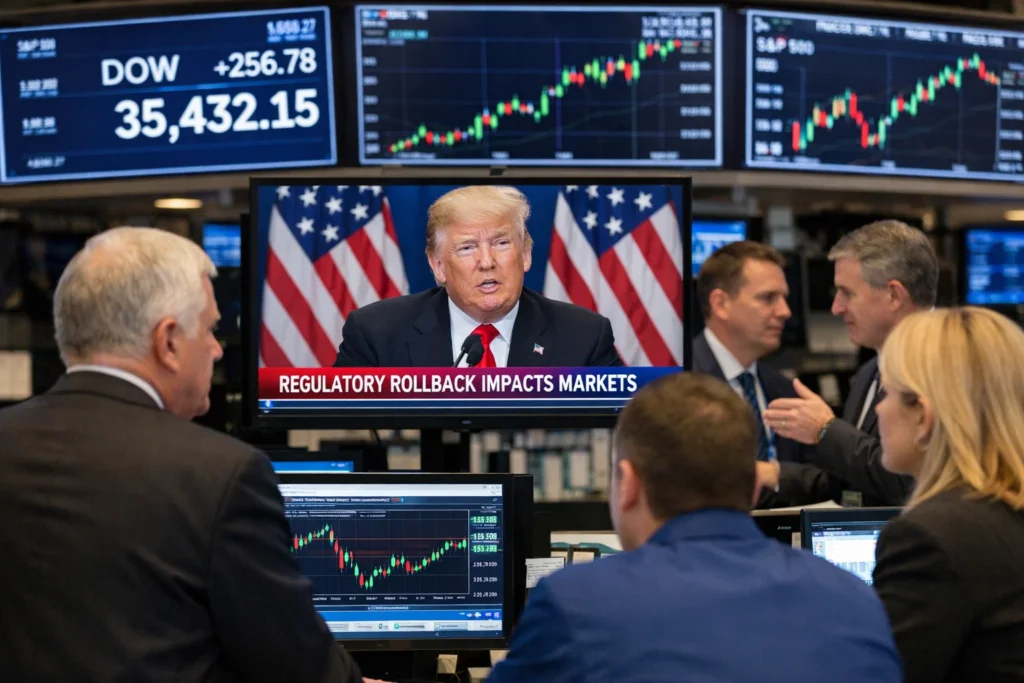
- Market sentiment: Stocks in sectors most affected by regulation (banking, energy, telecom) have shown a modest lift on the policy signal; traders describe the effect as a “regulatory relief rally,” though sentiment remains sensitive to legal and geopolitical headlines.
What regulators are changing internally
Several supervisory bodies have moved to align with the White House direction by streamlining review units, delaying certain rulemakings and directing teams to focus on the most acute consumer-safety risks rather than a broad list of compliance “observations.” One major supervisory agency has announced staff reductions in its oversight arm—an operational signal that supervision intensity may be reduced long term. Observers warn that fewer examiners and a narrower mandate could create blind spots.
Legal and governance risks to watch
- Statutory limits and litigation risk: Agencies cannot lawfully evade congressionally mandated rules simply because of an executive order; rollback attempts that short-circuit required procedures invite litigation and likely judicial review. That legal uncertainty creates transition risk for regulated firms.
- Regulatory arbitrage and systemic risk: Lightened oversight can encourage regulatory arbitrage (shifting risky activity to lightly supervised entities) and raise systemic concentrations. Market participants should weigh short-term cost savings against potential long-term stability costs.
- Political and reputational risk: Firms that relax compliance programs in response to lighter supervision may face reputational headwinds with investors, counterparties and clients who value robust consumer and operational protections. Congressional oversight hearings are a plausible follow-up.
Practical checklist — what firms should do now
(Use as an internal action plan; legal counsel recommended.)
- Reassess compliance posture, don’t abandon it. Perform a targeted risk assessment: identify critical controls that must remain even if supervisory touchpoints decline.
- Document decision-making. If you alter monitoring or testing frequency to capture cost savings, document the rationale and board approvals—useful evidence if regulators or plaintiffs later question the change.
- Stress-test liquidity and counterparty exposure. Reduced oversight doesn’t eliminate market shocks; run 12- and 24-month stress scenarios focused on credit, market-risk and operational contingencies.
- Engage with supervisors proactively. Shorter, clearer reports and voluntary briefings can preserve constructive supervisor relationships even as formal exams decline.
- Watch for legal developments. Track pending litigation or congressional letters that could restore or harden regulatory obligations quickly.
These steps preserve optionality: firms can capture efficiency gains while avoiding the legal and reputational costs of hasty deregulatory moves.
What this means for consumers and investors
- Consumers: In the near term, lighter regulation could mean lower fees or more product offerings as providers cut compliance costs. However, protections that prevent predatory conduct or ensure product safety could be rolled back or enforced less vigorously. Consumers should read product terms carefully and monitor service-provider disclosures.
- Investors: Reduced regulatory friction can support near-term earnings, but strategists caution investors to model increased tail-risk and policy reversals into valuations—especially for banks and highly leveraged financial firms.
Bottom line
The White House executive order has produced a tangible easing of federal regulatory pressure as experienced on Wall Street: fewer supervisory intrusions, accelerated rule reviews, and a lighter compliance calendar for many firms. Those shifts can lower operating costs and spur activity, but they bring trade-offs. Legal limits on rulemaking, potential market-stability consequences, and political pushback mean this deregulation is neither absolute nor risk-free. Firms and investors should treat this moment as an opportunity to optimize—not to cut—risk controls.
Disclaimer: This report summarizes public reporting and market commentary. It is informational and not legal, regulatory, or investment advice. Firms should consult counsel and their regulators for binding guidance.