
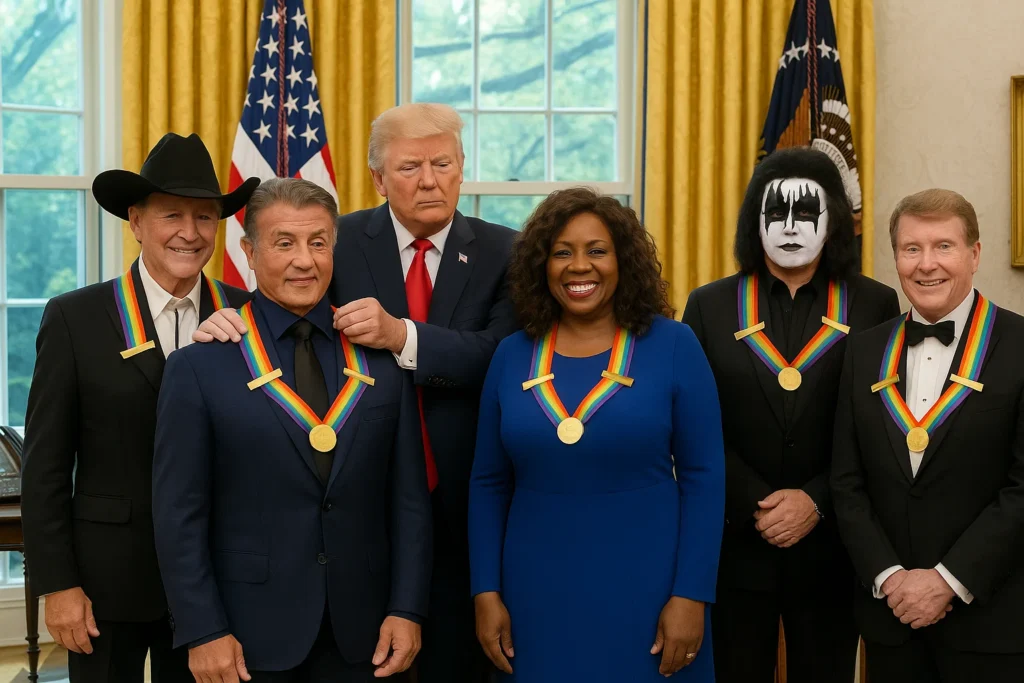
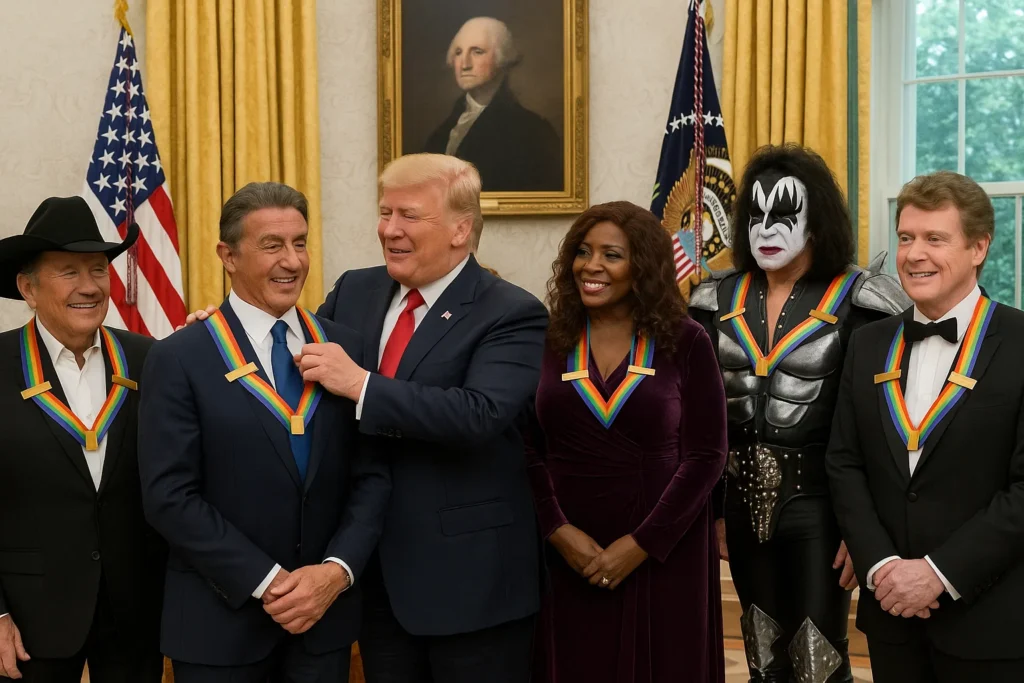
President Donald Trump hosted the 2025 Kennedy Center honorees in the Oval Office on Saturday, presenting medallions and joining a State Department dinner that capped the week’s festivities.
The medal presentation marks a high-visibility moment as the Kennedy Center reports record fundraising for the 48th Honors.
This article explains who was honored, why the ceremony mattered, how the fundraising milestone reshapes the calendar, and what critics and supporters are saying — step by step and in plain language.
Quick facts — the essentials
Trump presented medals to the 2025 honorees — including Sylvester Stallone, George Strait, Gloria Gaynor, Kiss, and Michael Crawford — in the Oval Office ceremony.
The Kennedy Center’s Honors for 2025 generated a record haul this year, with fundraising that officials call the largest in the program’s history.
The honorees’ formal tribute performances will be recorded and broadcast later in December as part of the televised Kennedy Center Honors special.
This is the first year Trump has taken a visibly central role in the ceremony after reshaping the Kennedy Center’s leadership since returning to office.
Who the honorees are — a snapshot
This year’s class mixes country, pop, rock and stage: George Strait, Gloria Gaynor, actor Sylvester Stallone, the rock band Kiss, and British actor-singer Michael Crawford.
Organisers and the president described the group as a cross-genre collection with broad audience appeal.
Honours like these celebrate lifetime contributions to American performing arts and traditionally culminate in a gala and a television special that raises public awareness and philanthropic dollars.
This year’s slate was notable both for its star power and for the administration’s involvement in selecting and promoting the class.
The fundraising milestone — record-breaking receipts
Organisers report the 48th Kennedy Center Honors raised roughly $23 million, a figure described internally as a record for the event and nearly double last year’s tally.
Fundraising officials say the increase reflects renewed corporate and donor interest since the Kennedy Center’s board and leadership were reshaped earlier in the year.
Those dollars underwrite the gala, television production costs, educational programming and a portion of the Kennedy Center’s artistic budget for the coming year.
Philanthropic directors note that large one-time gifts amplify immediate programming options but that sustained annual giving is what stabilises long-term arts budgets.
Why the Oval Office ceremony is a departure from tradition
Historically, medal presentations and the televised gala have been more ceremonially separated from day-to-day White House operations.
This year’s Oval Office medal presentation — and the president’s high-profile role — signals a change in how the Honors are staged and promoted.
Critics say presidential involvement can politicize what was meant to be a nonpartisan cultural recognition; supporters argue a visible presidency raises the event’s profile and donor interest.
That tension between cultural symbolism and political theatre is part of the larger discussion about government and arts patronage.
What Trump and the Kennedy Center leadership said
Trump praised the honorees’ careers and said he personally supported their selection, framing the class as “perhaps the most accomplished and renowned” ever chosen.
Kennedy Center leadership, which now includes Trump appointees, backed the statement and highlighted the gala’s fundraising success as evidence of revived support.
White House remarks emphasised the cultural and economic value of the arts, and organisers underscored that funding from donors helps keep performances, educational outreach and artist residencies active.
Those messages aim both to celebrate the arts and to encourage continued private-sector backing for public programming.
Reactions from the arts world and public
Reactions split along predictable lines: many artists and fans congratulated the honorees for decades of work, while some cultural figures expressed concern about political influence over arts institutions.
Veteran commentators observed that the optics of a presidentially led ceremony can overshadow artistic recognition and complicate advertiser and sponsor relationships.
Still, the headline-grabbing fundraising success has tempered some critique, since stronger funding can expand programming and accessibility — a point defenders of the administration emphasise.
Observers note that how the money is used in coming months will matter more than the figure itself in letters to donors and board briefings.
Televised gala and audience expectations
The Kennedy Center Honors television special, recorded during the tribute performances, will air later in December and feature celebrity tributes, performances and acceptance moments.
Producers hope the combination of classic hitmakers and heightened publicity will attract a robust television audience and streaming viewership.
Television ratings are important because they shape future underwriting opportunities and sponsorship packages; the more viewers, the easier it is to justify corporate backing.
If the broadcast draws strong numbers, it could reinforce the case that presidential involvement boosted public interest and sponsor confidence.
The politics of patronage — why donors matter now
Fundraising at this level reflects both cultural capital and political signaling: large donors often seek recognition and the soft power that comes with visible generosity.
The Kennedy Center is a major national institution; big gifts can influence programming, endowment growth and outreach initiatives.
Policy-minded donors will watch governance changes closely, asking whether board reshuffles or leadership shifts alter artistic independence or programming priorities.
Transparency about gift agreements and earmarked uses is crucial to maintain donor trust and public legitimacy for a national cultural institution.
What to watch next — practical signals and timelines
Watch the televised special’s ratings and sponsor lists after the broadcast to measure the publicity payoff.
Check Kennedy Center announcements for how the $23M will be allocated — especially to education, community engagement and touring programs.
Also watch for any follow-up statements from arts groups or prominent artists that could indicate deeper unease or acceptance of the new leadership direction.
If the Kennedy Center publishes an audited giving report, it will offer a clearer picture of donor concentration and long-term sustainability.
Do you think presidential involvement helps or hurts national arts events like the Kennedy Center Honors?
How we reported this
This article synthesises reporting from Associated Press, Reuters and major national outlets covering the Oval Office ceremony and the Kennedy Center’s fundraising figures.
Key facts used here — the honorees, the Oval Office presentation and the fundraising total — come from contemporaneous news coverage and Kennedy Center briefings.
Disclaimer: This article summarises reporting and public statements available as of the update time.
It is informational only and not an endorsement; for official statements and gift-usage details consult the Kennedy Center’s public filings and announcements.