
Key points
- Eric Trump and Donald Trump Jr. are backing Powerus, a new drone maker that plans to scale rapidly and target Pentagon business amid tighter U.S. restrictions on Chinese drones.
- Powerus is expected to go public via a reverse merger with small Nasdaq issuer Aureus Greenway Holdings — a move that sent Aureus shares sharply higher on the news.
- The Trump sons’ involvement follows separate Trump-linked investments in other drone/defense deals (including Eric Trump’s participation in a merger involving Israeli firm XTEND), raising immediate ethics and conflict-of-interest questions given the company’s aim at Pentagon sales.
- The news arrives as the Pentagon expands programs to buy domestically produced drones (including a large “Drone Dominance” effort), creating a potentially lucrative market for new entrants.
Trump Sons Back New Drone Company— what just happened
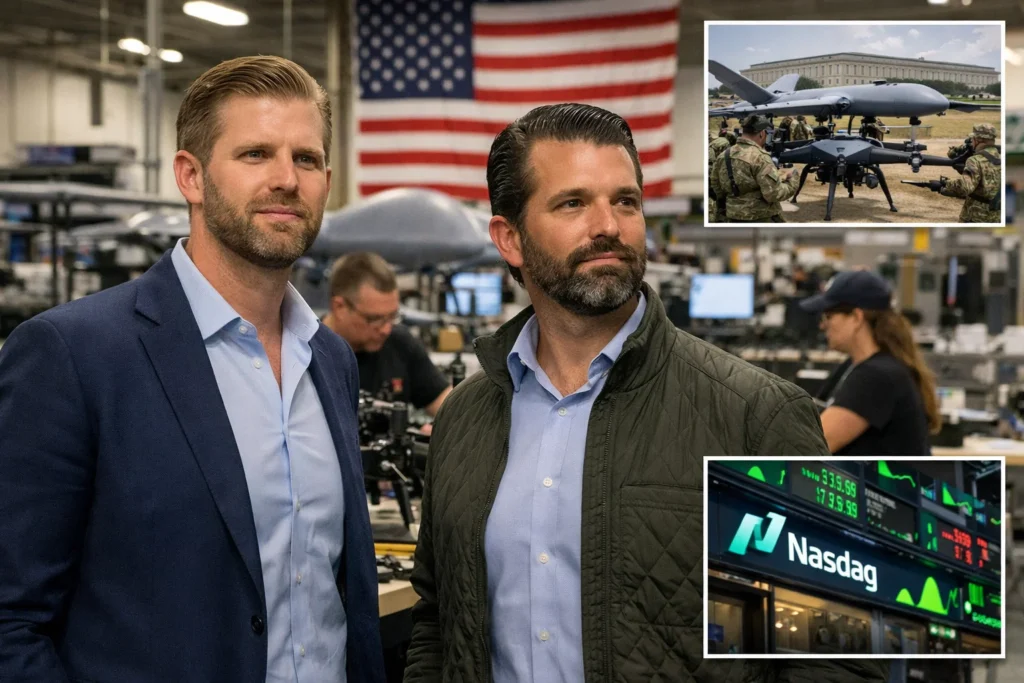
Two of former President Donald Trump’s sons are backing a newly public-bound drone company, Powerus, that aims to supply the U.S. Department of Defense as Washington moves to curb imports of Chinese drones and scale domestic drone production. The deal is being structured as a reverse merger with Aureus Greenway Holdings and has captured investor and media attention for both its business implications and the ethical questions it raises.
The business picture — Powerus, Aureus and the reverse merger
Powerus, founded in 2025, manufactures heavy-lift and specialty unmanned systems and has pursued acquisitions to accelerate scale. To access public capital and expand production, Powerus plans to merge with Aureus Greenway — a small, publicly traded company — which would give Powerus a Nasdaq listing without a traditional IPO. Aureus shares jumped sharply on the announcement as investors priced in potential Pentagon demand.
Why a reverse merger? For fast-growing startups in defense tech, reverse mergers can provide quicker access to capital markets, favourable tax/timing outcomes and an easier route to build supplier relationships and scale production — all valuable if a large government procurement window is opening.
Who’s involved and why it matters
Reporting identifies both Eric Trump and Donald Trump Jr. among financial backers or advisers tied to the broader set of drone investments and corporate structures that include Powerus, Unusual Machines (linked to Trump Jr.), Dominari Securities and other Trump-affiliated investment vehicles. Separately, Eric Trump is part of a $1.5 billion transaction tied to Israeli drone maker XTEND that also aims at U.S. defense sales — a tie that underscores the family’s growing footprint in drone supply chains.
That footprint matters because Powerus explicitly plans to chase Pentagon contracts and scale production rapidly. Where senior political families have commercial interests in suppliers to the U.S. government, media and watchdog groups typically flag conflict-of-interest risks and call for transparent ethics reviews — especially if any former or sitting officials could influence procurement priorities or policy.
Market and policy context — why demand is rising now
Two policy trends power this opportunity:
- Restrictions on Chinese drone imports and heightened supply-chain scrutiny have created a gap the Pentagon now wants to fill with domestically sourced or allied suppliers.
- Pentagon procurement pushes such as the large-scale “Drone Dominance” initiatives and other modernization efforts have put public funds and procurement pathways within reach for companies able to scale production and meet security vetting. Powerus and similar entrants aim to capture a slice of that budget.
Investors reacted quickly to the news — smaller defense-tech names and companies in the merger chain saw upticks in trade and valuations on the expectation of lucrative government contracts.
Ethics, oversight and conflict-of-interest concerns
The optics of presidential family members backing firms that may sell to the Pentagon are sensitive:
- Procurement integrity: Federal contracting has layers of oversight — security clearances, FAR rules, and inspector-general review — designed to prevent improper influence. Those safeguards will be central if Powerus wins major awards.
- Disclosure & recusal: Any perceived link between political actors and procurement officials typically triggers calls for strict disclosure, and sometimes recusals or additional transparency from agencies.
- Watchdog scrutiny: Expect press investigations, congressional queries (if the company gains sizeable Pentagon business), and attention from ethics watchdogs. Early coverage already flags these concerns.
What to watch next — signals that matter
- SEC filings and merger documentation: The S-4 or proxy materials for the Aureus–Powerus transaction will reveal ownership stakes, board composition, capital plans and lock-ups. (Short term.)
- Pentagon procurement notices: Winning contracts, awardees lists, or inclusion on vendor panels for Drone Dominance and related programs would be the clearest sign Powerus is converting investor interest into sales. (Weeks → months.)
- Ethics disclosures or congressional interest: Any inquiries from House or Senate oversight committees or public statements by ethics offices would shape the public debate. (Ongoing.)
- Market moves: Stock performance for Aureus and peers, plus M&A news in the drone sector, will show investor appetite for defense-tech plays.
What this means for readers (plain language)
- For investors: this is a high-risk, high-reward play. If Powerus successfully scales and wins Pentagon business, early investors may profit — but defense contracting is slow, heavily regulated and politically sensitive.
- For taxpayers and voters: procurement transparency matters — public oversight helps ensure contracts are awarded on capability and value, not proximity to political influence.
- For the defense industrial base: expect larger primes to watch closely; incumbents may respond by accelerating their own drone strategies or partnering with fast-moving entrants.