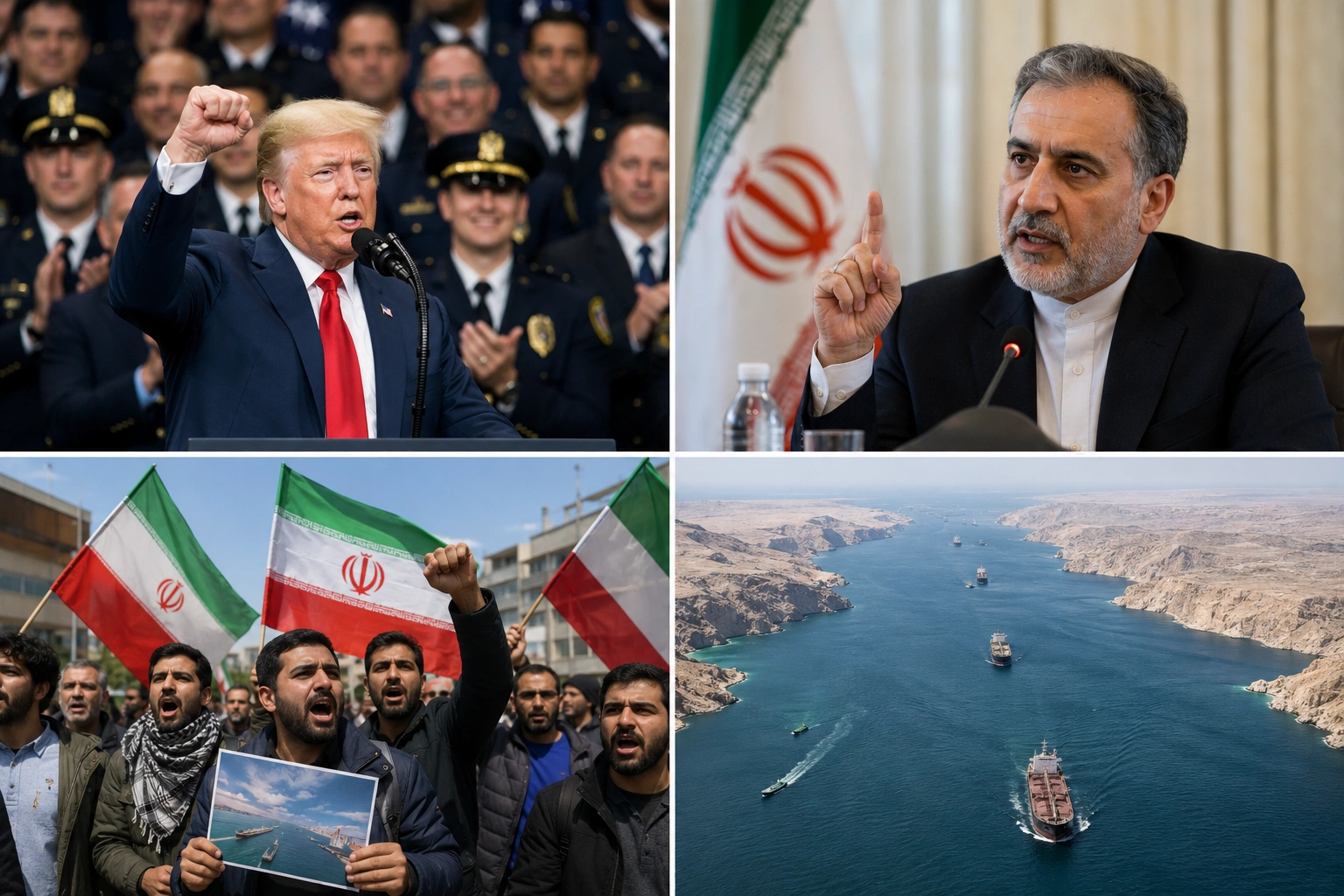
Key Points: Trump Hormuz US Territory Claim Stuns Legal Experts
- Trump Hormuz US territory declaration would come “after we finish defeating Iran”
- He made the announcement in New York, telling a cheering law enforcement crowd
- Iran’s deputy foreign minister rejected the claim, saying the strait “cannot be seized”
- The waterway is actually shared jurisdiction between Iran and Oman, not US territory at all
President Trump just made one of the boldest territorial claims of his presidency, promising to declare control over a waterway America has never legally owned.
What The Trump Hormuz US Territory Claim Actually Says
Speaking Friday at an event in Garden City, New York, supporting Republican gubernatorial candidate Bruce Blakeman, Trump told a cheering crowd of law enforcement officers exactly what he’s planning.
“After we finish defeating Iran, which is being very badly defeated, pretty soon I’ll be declaring the Hormuz Strait a territory of the United States,” Trump said, delivering the line with a chuckle.
Here’s how he framed America’s current position over the waterway. “We have the blockade. No ships get through unless we want them to,” Trump added, describing what he sees as functional control already in place.
Why This Claim Faces A Serious Legal Problem
Here’s the geographic reality complicating Trump’s announcement. The Strait of Hormuz sits between Iran’s northern coast and Oman’s southern coast, connecting the Persian Gulf to the Gulf of Oman.
Neither country has ever ceded jurisdiction to the United States, and international maritime law has historically protected free transit through waterways like this one for commercial shipping.
Legal experts have already raised similar concerns about a related Trump proposal, floated last month, to charge a 20% toll on goods passing through the strait as a self-declared “guardian” of the waterway.
How Iran Responded To The Announcement
Iran’s deputy foreign minister, Kazem Gharibabadi, fired back almost immediately on social media, delivering one of the sharpest rebukes of the war so far.
“The Strait of Hormuz cannot be taken over by a tweet, nor by an aircraft carrier, nor by issuing a decree, nor by an election speech,” Gharibabadi wrote, directly mocking Trump’s method of announcement.
Iranian officials separately insisted the strait “will remain Iranian,” rejecting any suggestion that US military pressure changes underlying legal sovereignty over the waterway.
Why This Matters Beyond The Rhetoric
Here’s the real-world stakes behind this specific chokepoint. Roughly 20% of the world’s seaborne oil and gas supply normally flows through the strait, making it one of the most economically consequential waterways on earth.
Iran effectively closed the passage following February’s outbreak of war, and a June ceasefire memorandum required reopening it, an agreement now set to expire amid stalled negotiations.
Trump directly acknowledged the economic cost of this standoff too, telling the crowd, “For you to pay a tiny little bit more for your gasoline, just remember you’re doing it so that a very evil country cannot have a nuclear weapon.”
With ceasefire talks faltering and Trump’s territorial claim carrying no clear legal mechanism behind it, this Hormuz standoff looks likely to remain one of the war’s most volatile and economically consequential flashpoints in the weeks ahead.