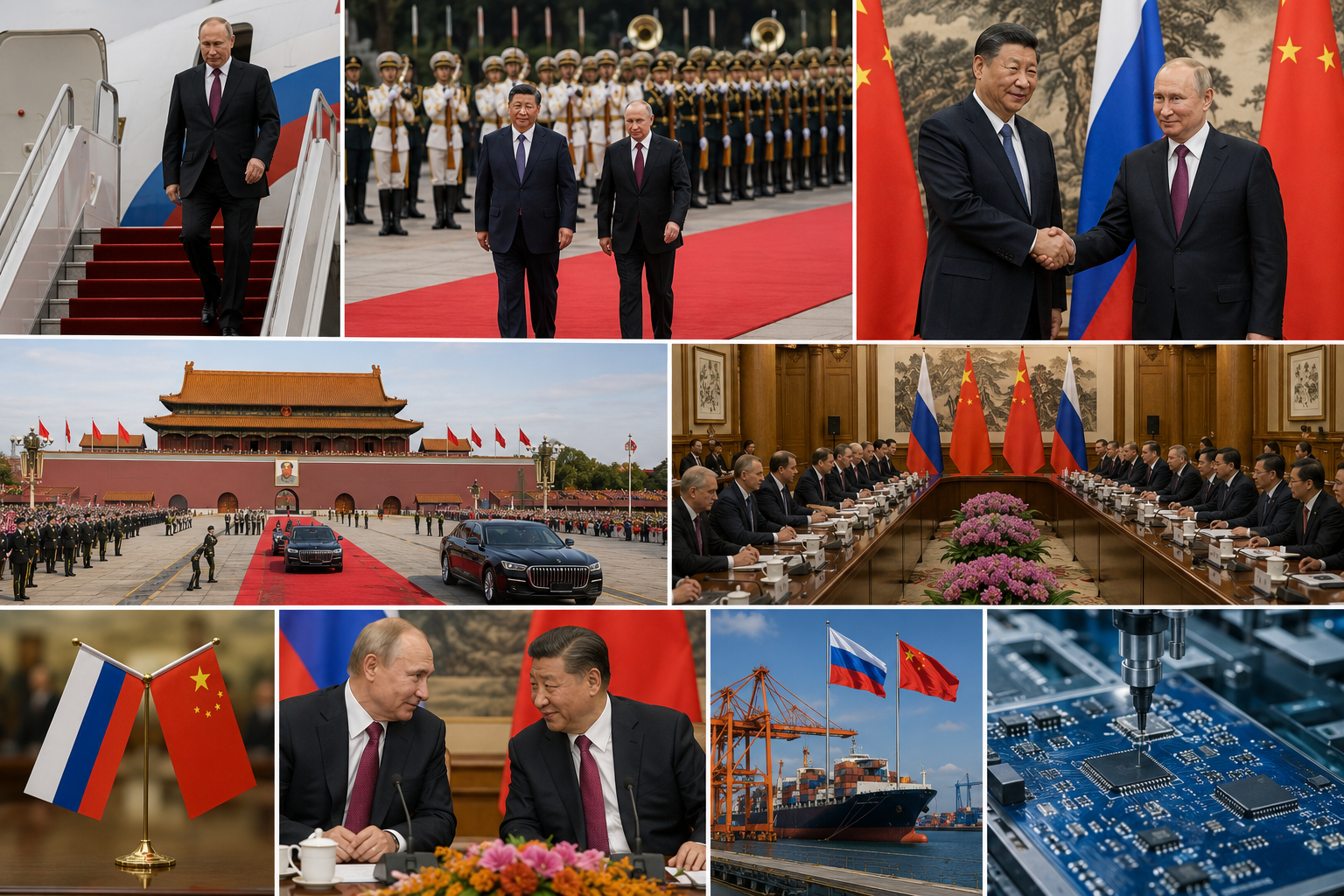
► Key Points – Putin Arrives in Beijing Days After Trump
- Russian President Vladimir Putin arrived in Beijing on May 19 — his 25th visit to China — just days after Donald Trump’s own state visit to Xi Jinping
- Putin was welcomed with the same red carpet, military band, and Great Hall of the People ceremony afforded to Trump — a deliberate signal from Xi
- The Xi-Putin Beijing Summit May 2026 is Putin’s most important visit yet: Russia’s economy is contracting and it needs China more than ever
- Analysts say “China holds all the cards” — the Russia-China relationship has become deeply asymmetric, with Moscow firmly in the junior seat
- The two leaders plan to sign a joint declaration on “establishing a multipolar world” and a “new type of international relations”
- China supplies 90% of Russia’s dual-use technology for its war in Ukraine — a fact the EU sanctioned Chinese entities for in April 2026
- Putin arrives anxious: he needs reassurance that Xi’s warm meeting with Trump has not tilted Beijing toward Washington
By TrenBuzz Staff · May 20, 2026 · 5 min read
The red carpet had barely been rolled up after Donald Trump’s departure from Beijing when it was unfurled again. This time, the guest walking across it was Vladimir Putin — and the subtext could not have been louder. Within the span of six extraordinary days, Chinese President Xi Jinping hosted the leaders of both the United States and Russia at the Great Hall of the People, cementing Beijing’s position as the indispensable capital of a fractured world.
The Putin Xi Beijing Summit May 2026 — Putin’s 25th visit to China — is being framed publicly as a celebration of a 25-year friendship treaty and a milestone in their “no-limits” partnership. Beneath the ceremony, however, simmers something more complicated: a relationship that has grown increasingly lopsided, where Russia arrives needing reassurance and China dispenses it on its own terms.
As one senior analyst put it bluntly: “China holds all the cards.” And everyone in the room on Wednesday knows it.
The Sequence That Spoke Louder Than Any Statement
The timing of Putin’s Beijing visit was not accidental — and it was not lost on anyone watching. Trump left China on May 15 having declared “fantastic deals” with Xi. Putin arrived on May 19 for his own state visit, almost as if Beijing were running a diplomatic relay race, one superpower baton passed to the next.
Experts say the back-to-back visits are a masterstroke for Xi. “The message is clearly one that China maintains friendship and strategic partnership with whichever power it likes, and the USA is just one of them,” one analyst told NPR. For Xi, hosting both Trump and Putin within a single week isn’t a contradiction — it’s the whole point.
Putin’s visit also means that within the span of six months, the leaders of the other four permanent members of the United Nations Security Council have all visited China — including French President Emmanuel Macron in December 2025 and British Prime Minister Keir Starmer in January. Beijing is now, unambiguously, the world’s most sought-after diplomatic address.
“Rather as Trump went cap in hand to Beijing, so will Putin. China has all the cards.”
— Timothy Ash, Associate Fellow, Chatham House Russia and Eurasia Programme
Why Putin Needs This Summit More Than Xi Does
Russia arrived in Beijing in a position of quiet vulnerability. Moscow slashed its growth forecast for this year to 0.4% from 1.3% as its economy reels from Ukrainian attacks on oil infrastructure and export terminals that underpin Russian war financing. The war in Ukraine grinds on, and the war in Iran — while benefiting Russia’s oil revenues — has introduced new uncertainty into global energy markets that even Moscow can’t fully control.
Putin needs Xi to confirm one thing above all else: that the Trump-Xi summit did not secretly tilt China toward Washington. Putin will seek reassurance that any improvement in China’s ties with Washington will not alter the “strategic triangle” that keeps China and Russia closer than either is with the U.S. That reassurance is the real agenda behind every signed agreement and toasted friendship this week.
The Kremlin has signaled it also expects a “serious” oil and gas deal — specifically progress on the long-delayed Power of Siberia 2 pipeline, which would route Russian natural gas directly to China. The pipeline took a step forward in September 2025 and both sides are expected to push it closer to finalization in Beijing this week.
🔗 Also Read:Trump-Xi Summit 2026: “We Settled a Lot” — What Actually Happened in Beijing
The “No-Limits” Alliance — and Its Very Real Limits
When Putin and Xi declared their “no-limits” partnership in February 2022, just days before Russia invaded Ukraine, it sounded like a seismic shift in global power. Four years on, the limits of that partnership are becoming clearer — and they run almost entirely in Beijing’s favor.
In 2025, trade between the United States and China reached $414.7 billion, nearly double the Sino-Russian volume of $234 billion. For all the rhetorical warmth between Moscow and Beijing, the economic reality is that China’s relationship with the U.S. is worth roughly twice what its relationship with Russia is worth in trade terms alone. That asymmetry quietly shapes every negotiation.
China has also drawn quiet lines it won’t cross. Xi’s “no limits” alliance with Putin has undercut China’s claimed neutrality on Ukraine — but Beijing has denied reports showing that Chinese firms have single-handedly sustained Russian drone production by shipping engines mislabeled as “industrial refrigeration units” to drone assembly plants. Meanwhile, the EU sanctioned Chinese entities over dual-use technology transfers to Russia in April 2026 — a move that put real pressure on Beijing’s balancing act.
Iran, Ukraine, and the Agenda Between the Lines
Xi and Putin are expected to discuss trade, the wars in Ukraine and Iran, and their vision for a world that’s not dominated by US-led alliances. They are also set to issue a joint declaration on “establishing a multipolar world” — diplomatic language that both nations use to signal opposition to what they call Western hegemony.
The Iran war looms especially large. Russia has benefited from the conflict — disrupted global energy flows have pushed oil prices toward $109 per barrel, keeping Moscow’s war economy afloat. China, by contrast, wants the Strait of Hormuz reopened, having agreed with Trump last week that Iran must not have nuclear weapons. The two allies don’t see the Iran war through the same lens — and that divergence will test how “no-limits” their partnership really is.
On Ukraine, China has provided roughly 90% of Russia’s dual-use technology for its war effort — but has stopped short of providing direct weapons. That line, quietly maintained, tells you everything about how Xi views the relationship: indispensable to Russia, but conditional on Chinese terms.
🔗 Also Read:The Emperor’s Price Tag: Xi Jinping Finally Stands Tall on the World Stage — At What Cost?
What This Week Tells the World
The image of Beijing hosting Trump and Putin in the same week — the same ceremonial venue, the same honor guards, the same diplomatic choreography — is one of the defining pictures of 2026. It confirms that Xi has achieved the global standing he sought: the leader every other leader must visit, must court, must reassure.
But the Xi-Putin meeting is also a reminder that every alliance has a price structure. Russia’s isolation from the West has made it structurally dependent on China in ways that were unimaginable a decade ago. Putin needs this more than Xi. Russia is now the junior, dependent partner, following Putin’s disastrous war in Ukraine.
The red carpet this week was the same one laid out for Trump. The ceremony was identical. But the power dynamics underneath them could not be more different — and the world is watching closely to see whether Beijing’s grand balancing act can hold as the pressure from Washington, Moscow, and Tehran all converge on the same address at once.
Disclaimer: This article is intended for informational and news reporting purposes only. The views and analysis expressed are based on publicly available information sourced from credible international news agencies and research institutions and do not constitute political, legal, or financial advice. TrenBuzz.com does not endorse any government, political figure, military action, or foreign policy position. All trademarks and names belong to their respective owners. Content is produced in compliance with Google AdSense publisher policies.