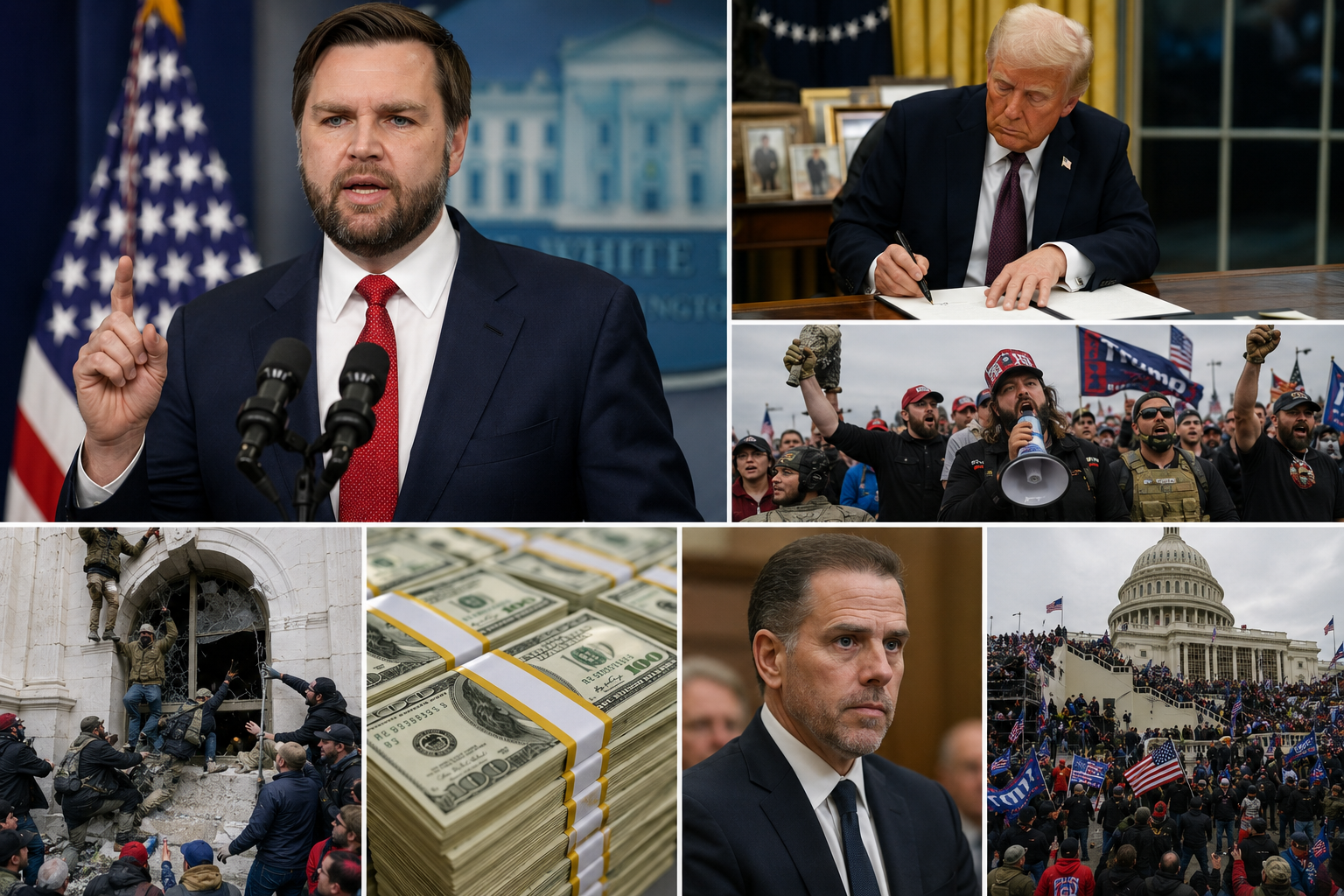
► Key Points – Vance Defends Trump’s $1.776 Billion Federal Compensation Fund
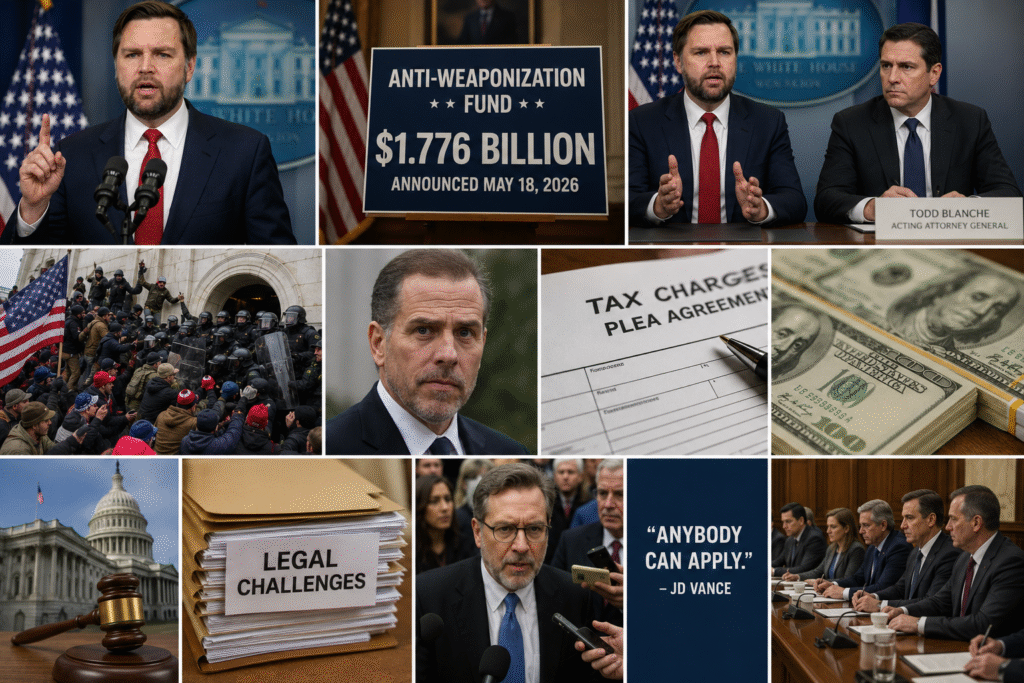
- The Trump DOJ announced a $1.776 billion Anti-Weaponization Fund on May 18, 2026 — set up as part of a settlement in Trump’s $10B IRS lawsuit
- VP JD Vance defended the Vance federal compensation fund at a May 19 White House briefing, saying “anybody can apply”
- Vance and Acting AG Todd Blanche declined to rule out payments to Jan. 6 rioters who attacked police officers at the Capitol
- Vance suggested Hunter Biden — who pleaded guilty to federal tax crimes in 2024 — could also be eligible to apply
- The fund has not been appropriated by Congress — drawing bipartisan criticism over its legality and lack of judicial oversight
- A lawyer representing more than 400 Jan. 6 defendants has already confirmed his clients will seek payments from the fund
- A five-person commission will review cases individually, but Acting AG Blanche admitted he has “no idea” if Trump will weigh in on appointments
By TrenBuzz Staff · May 20, 2026 · 5 min read
In one of the most extraordinary White House briefings of the year, Vice President JD Vance stepped to the podium on Tuesday and found himself defending a brand-new federal fund that nobody — not Democrats, not some Republicans, and not even the administration’s own allies — can fully explain. The Vance federal compensation fund story broke fast and hard, and by Wednesday morning it had consumed Washington.
The Trump administration’s Department of Justice announced on May 18, 2026 that it is establishing a $1.776 billion Anti-Weaponization Fund to compensate Americans who claim they were unfairly targeted by federal investigations or prosecutions under the Biden administration. Vance defended it. But then came the questions — and the answers made headlines of their own.
Could January 6 rioters who assaulted police officers receive taxpayer money from the fund? Could Hunter Biden apply? Vance’s response to both: “Anybody can apply.”
What Is the Anti-Weaponization Fund — and Where Did It Come From?
The fund traces its origins to a lawsuit President Trump filed against the Internal Revenue Service over the 2019–2020 leak of his personal tax returns by a contractor. Trump had sought $10 billion in damages — a staggering figure that set up years of legal maneuvering between the White House and federal agencies.
The settlement announced Monday resolves that lawsuit. Under the deal, Trump and his family agreed to drop multiple legal claims against the federal government in exchange for the creation of a pool of money — $1.776 billion — that would compensate people who say they were politically targeted by prior federal investigations or prosecutions during the Biden years.
Critically, the fund has not been appropriated by Congress. That detail alone has triggered alarm bells on both sides of the aisle, with critics pointing out that distributing nearly $1.8 billion in public funds without legislative approval may face serious legal challenges. Unlike previous victim compensation funds, there was also no judicial approval or oversight involved in Monday’s announcement.
“We’re not trying to give money to anybody who attacked a police officer; we’re trying to compensate people where the book was thrown at them, they were mistreated by the legal system.”
— VP JD Vance, White House Briefing, May 19, 2026
The Jan. 6 Question — and the Answer That Stunned the Room
The most explosive moment of Tuesday’s briefing came when reporters pressed Vance on whether January 6 defendants who physically attacked Capitol police officers could receive payments from the fund. Vance said those convicted of serious crimes “may not be eligible” — but critically, he did not rule it out, insisting every case would be evaluated “case by case.”
That answer landed like a grenade. Vance himself had previously suggested that people who attacked police officers should not receive taxpayer-funded compensation. The apparent contradiction drew immediate pushback — and reporters circled back to it repeatedly throughout the briefing.
The practical concern isn’t hypothetical. A lawyer representing more than 400 January 6 defendants confirmed to media outlets that his clients intend to apply for compensation from the fund. Whether the five-person commission reviewing applications will accept or reject those claims remains entirely unclear — because the criteria for eligibility haven’t been publicly defined.
🔗 Also Read:49 in One Shot: Senate Republicans Bulldoze Through Trump’s Nominee Backlog
Hunter Biden Could Apply Too — Vance Said So Himself
If the January 6 angle wasn’t enough, Vance added another layer that left political observers stunned. When pressed on the fund’s eligibility criteria, the Vice President openly suggested that Hunter Biden — who pleaded guilty to federal tax crimes during his father’s administration in 2024 — could apply for and potentially receive compensation.
“Republicans can apply for it. Democrats can apply for it,” Vance said. “As you know, the President of the United States has pardoned a number of Democrats who he felt were actually subject to this lawfare.” The logic, as Vance framed it, was that any American who believes they were politically prosecuted under Biden’s DOJ is eligible to seek compensation — regardless of party affiliation.
The framing drew both mockery and genuine policy concern. Critics noted the administration was simultaneously arguing the fund was designed to correct Biden-era abuse while opening it to virtually anyone — including people convicted of crimes the Trump administration itself had originally supported prosecuting.
Acting AG Blanche: “Full Transparency” — With Caveats
Acting Attorney General Todd Blanche appeared before a Senate appropriations subcommittee on the same day and faced equally pointed questions. Blanche committed to “making sure the commissioners are effectively doing their job” but could not name a single member of the five-person commission that will oversee fund disbursements — nor could he say how they would be selected.
When asked whether Trump would influence who sits on the commission, Blanche said he had “no idea.” On public disclosure of fund payments, Blanche promised transparency but left significant caveats that left Democratic senators unconvinced. Sen. Chris Coons pressed Blanche directly on whether disbursements would be subject to public disclosure — and did not receive a clear yes.
Sen. Chris Van Hollen also noted a key legal distinction: a previous victim compensation fund had received formal sign-off from a federal judge before distributing money, whereas Monday’s announcement involved no judicial review or approval whatsoever. That gap, legal experts say, could expose the fund to court challenges before a single dollar is distributed.
🔗 Also Read:The $1 Billion Ballroom Blowup: Senate Blocks Trump’s East Wing Security Funding
The Politics of a $1.776 Billion Question
The Anti-Weaponization Fund puts the Trump administration in a politically uncomfortable position it didn’t fully anticipate. Designed to play to the base — rewarding loyalists who believe they were persecuted by a weaponized Biden DOJ — the fund has instead generated a cascade of questions the White House doesn’t have clean answers to.
Bipartisan criticism has already emerged. Even some Republicans privately worry that payments to Jan. 6 defendants who attacked law enforcement would create a campaign liability heading into the 2026 midterms. Democrats have seized on the fund as evidence of the administration using the DOJ as a political instrument — the very accusation it’s supposedly designed to address.
For Vance, Tuesday’s briefing was a test — and by most accounts, it left more questions open than it answered. “Anybody can apply” is a politically flexible answer. But in Washington, flexibility on a $1.776 billion question tends to have a very short shelf life before Congress, the courts, or both, come looking for something more specific.
Disclaimer: This article is intended for informational and news reporting purposes only. The views and analysis expressed are based on publicly available information sourced from credible news agencies including AP, ABC News, Reuters, and TIME, and do not constitute legal, financial, or political advice. TrenBuzz.com does not endorse any political party, government policy, compensation claim, or legal position. All trademarks and names belong to their respective owners. Content is produced in compliance with Google AdSense publisher policies.