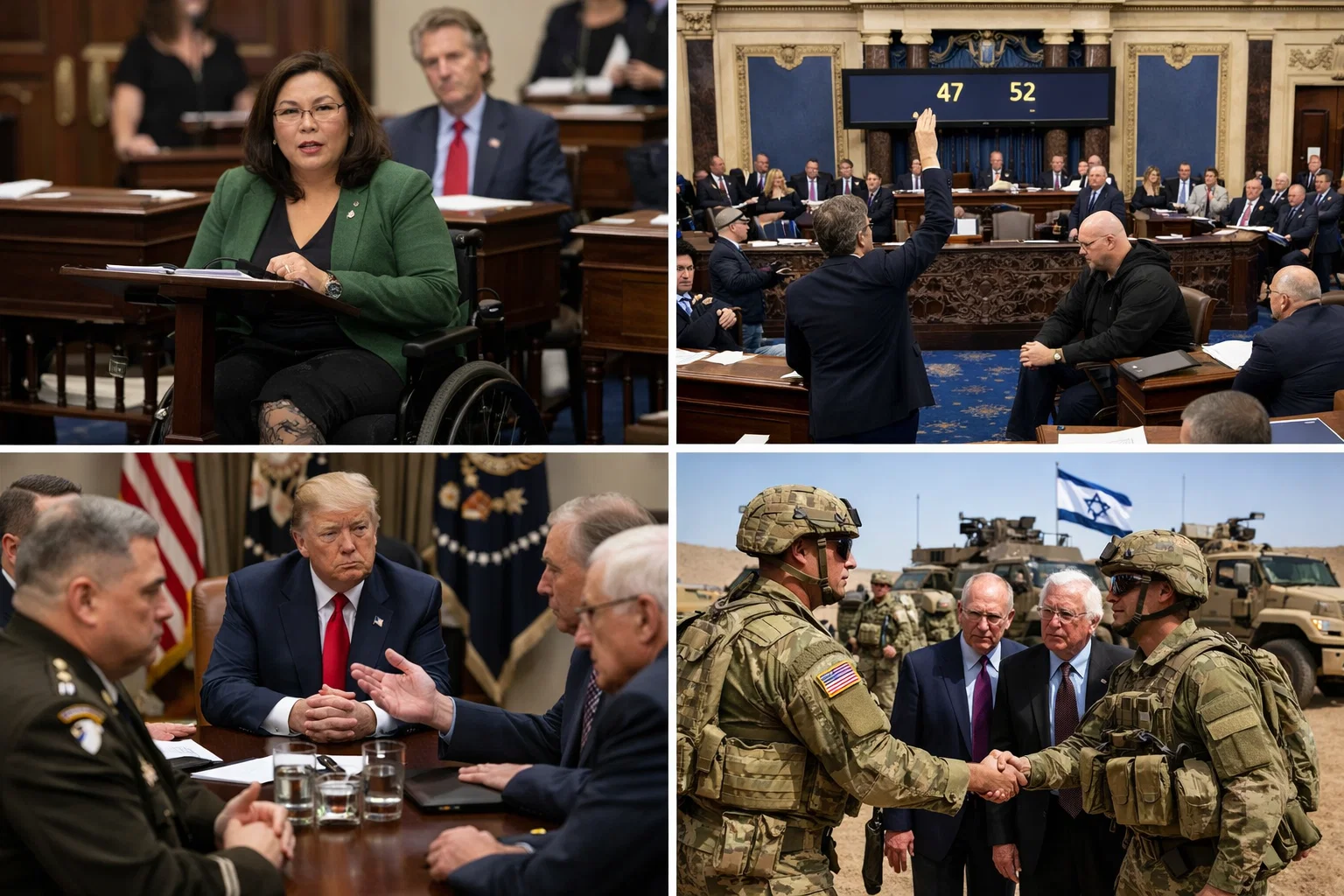
For the fourth time in 2026, Republican senators have voted to hand President Trump unchecked military authority over the Iran war — but a constitutional deadline on April 29 may finally force their hand.
By TrenBuzz Staff | Washington, D.C. | April 15, 2026 | 5 min read
Key Points
- The Senate rejected a war powers resolution on April 15 in a 47–52 vote — the fourth failed attempt this year.
- Sen. Tammy Duckworth (D-IL), an Army combat veteran, introduced the resolution calling the Iran conflict an “illegal war of choice.”
- The vote fell mostly along party lines; Sen. Rand Paul (R) voted yes, Sen. John Fetterman (D) voted no.
- Under the War Powers Act of 1973, Trump must seek congressional authorization by May 1 or legally begin withdrawing forces.
- The U.S. military campaign in Iran began February 28 alongside Israel, without a formal congressional declaration of war.
- Democrats have vowed to force a new vote every week until the war ends or Congress acts.
- Some Republicans privately acknowledge the 60-day deadline is a legal line they cannot ignore.
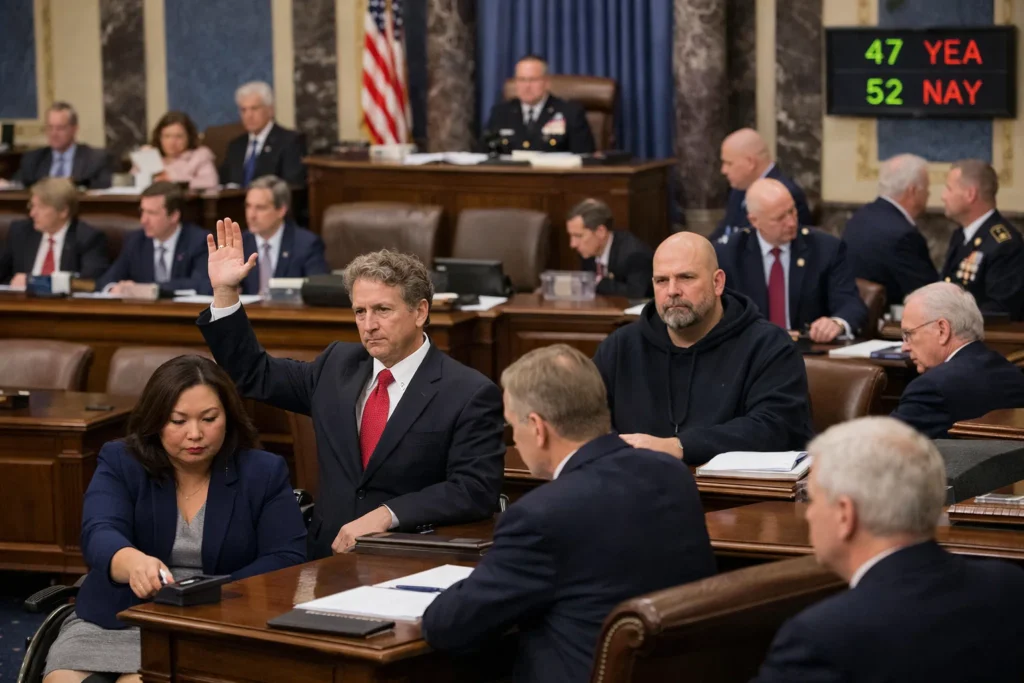
The U.S. Senate on Wednesday again rejected a war powers resolution that would have required President Donald Trump to withdraw military forces from Iran without a formal congressional authorization marking the fourth consecutive defeat of such a measure in 2026.
The resolution, introduced by Sen. Tammy Duckworth of Illinois — a decorated Army veteran who lost both legs in combat — failed 47–52, almost entirely along party lines. One Republican, Sen. Rand Paul of Kentucky, voted in favor. One Democrat, Sen. John Fetterman of Pennsylvania, voted against.
But the real story is not Wednesday’s vote. It’s what happens in exactly 14 days.
How the U.S. Ended Up at War With Iran — Without Congress
On February 28, 2026, President Trump launched military strikes against Iran alongside Israel, without seeking a formal congressional authorization for the use of military force. The administration cited Iran’s nuclear program, decades of regional aggression, and an “invasion” of U.S. interests as justification.
Critics immediately challenged the legality of the move, pointing to the U.S. Constitution, which reserves the power to declare war exclusively for Congress. The Trump administration has offered shifting legal rationales, including arguing that the totality of Iran’s hostilities since 1979 constitutes an ongoing act of aggression.
The war has already cost the lives of more than a dozen American service members and is spending billions of dollars per week, according to lawmakers briefed on the conflict.
What Wednesday’s Senate Vote Actually Means
The war powers resolution that died Wednesday would have triggered a mandatory U.S. military withdrawal from Iran unless Congress passed a separate law authorizing the conflict to continue. Even supporters acknowledged the resolution’s limits — it would have been largely symbolic since Trump could veto it, and a two-thirds override is considered out of reach.
Senate Minority Leader Chuck Schumer called the Republican position unconscionable, noting that gas prices are surging, American lives are being lost, and “the American people literally cannot afford for Republicans to forgo another opportunity to work with Democrats to end Trump’s disastrous war.”
Sen. Chris Murphy called the conflict a “bungled, mismanaged war” that has failed to achieve the administration’s stated goals, adding that it had “erupted a regional war throughout the Middle East and is literally melting down economies all over the world.”
“As our troops continue to sacrifice whatever is asked of them, we senators need to do the absolute minimum required of us.”— Sen. Tammy Duckworth (D-IL), Iraq War Veteran, April 15, 2026
The Clock No One Can Stop: The 60-Day War Powers Deadline
Under the War Powers Act of 1973, any president who commits U.S. forces to hostilities without a congressional declaration of war must notify Congress within 48 hours — and then must terminate those operations within 60 days unless Congress authorizes them to continue. Trump formally notified Congress of the Iran strikes on March 2, making May 1, 2026 the hard legal deadline.
The law permits one 30-day extension, but only if the president certifies in writing that additional time is needed to safely withdraw troops. No such certification has been filed, and Congress has passed no authorization for the use of military force in Iran. Rep. Don Bacon (R-NE) put it plainly: “By law, we got to either approve continued operations or stop.”
Some Republicans, privately nervous about the deadline, are signaling that a war funding vote — expected when the White House submits its supplemental budget request — may be the real inflection point. “The war funding will be the big vote,” said Sen. Jim Lankford (R-OK). [INSERT IMAGE HERE: War Powers Act / U.S. Capitol / Iran ceasefire talks in Islamabad] Talks in Islamabad, Pakistan, failed to yield a lasting ceasefire agreement, though both the U.S. and Iran have signaled openness to a second round. (File photo)
A Fragile Ceasefire — and What Comes Next
Wednesday’s Senate vote came one week after the U.S. and Iran agreed to a two-week ceasefire. Subsequent diplomacy in Islamabad, Pakistan, broke down without a more permanent agreement, though both sides expressed openness to further talks. Meanwhile, CENTCOM confirmed that the U.S. naval blockade in the Strait of Hormuz remains active, with nine vessels turned back over a 48-hour period.
Treasury Secretary Scott Bessent signaled Washington was also preparing what he called “the financial equivalent of bombing” Iran — a new wave of sweeping economic sanctions. The combination of military pressure, diplomatic back-channels, and growing domestic political scrutiny has created a volatile atmosphere in Washington unlike any since the Iraq War era.
Democrats have vowed to force a fresh war powers resolution vote every single week. Sen. Richard Blumenthal confirmed the party’s strategy: “We’re going to do it again and again and again. We’re going to hold Republicans accountable.”
Why Every American Should Be Watching This
The debate over the Senate war powers resolution is not just about Iran. It’s about whether the constitutional balance of power between Congress and the presidency still means anything in the modern era. Congress has not formally declared war since World War II, and the War Powers Act of 1973 has rarely been enforced against a sitting president.
If Trump ignores the May 1 deadline — or if Congress simply looks the other way — it would set a precedent with consequences far beyond this conflict. The question of who decides when America goes to war has never been more urgent, or more unresolved.
Senate Rejects War Powers Resolution: The next war powers vote is expected as early as next week. And the countdown to May 1 has already begun.
Disclaimer: This article is published for informational and news reporting purposes only. All information is based on publicly available sources as of April 15, 2026. TrenBuzz.com does not express any political, military, or legal opinion on the U.S.–Iran conflict or related legislative matters. Readers are encouraged to consult official government and legal sources for authoritative information.