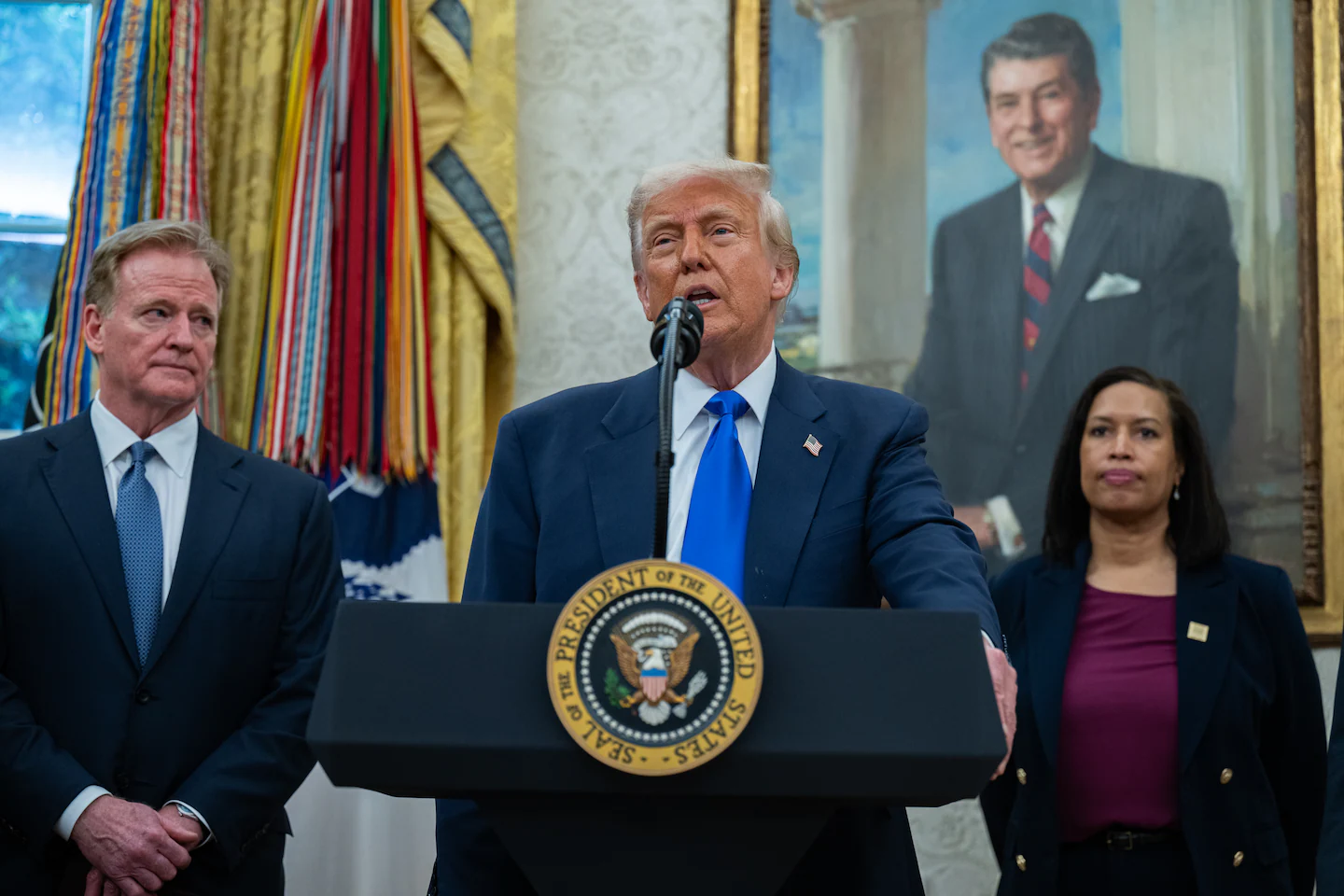
He never played a professional game. He could barely see the field. But without him, there might be no NFL at all — and now the Trump administration wants him in Canton.
Key Points at a Glance
- Interior Secretary Doug Burgum publicly pushed for Theodore Roosevelt’s induction into the Pro Football Hall of Fame at an April 17, 2026 event.
- Burgum met with NFL Commissioner Roger Goodell about the proposal, saying “I think we’re going to see Theodore Roosevelt inducted.”
- Roosevelt never played professional football — but in 1905 he personally brokered rule reforms that saved the sport from being banned nationwide.
- His reforms led to the legalization of the forward pass, creation of the neutral zone, and the founding of what became the NCAA.
- The Hall of Fame’s Contributor category — for non-players who shaped the sport — makes Roosevelt eligible under updated 2024 selection rules.
- The proposal has sparked both bipartisan buzz and political backlash, with critics noting the irony of honoring TR given current land policy reversals.
It’s the most unexpected Hall of Fame push in recent memory. The Trump administration is quietly — and now not-so-quietly — lobbying to get President Theodore Roosevelt inducted into the Pro Football Hall of Fame in Canton, Ohio. And according to Interior Secretary Doug Burgum, it might actually happen before the end of 2026.
Burgum made the stunning disclosure on April 17, 2026 at a National Portrait Gallery event tied to the Theodore Roosevelt Presidential Library. “Keep it a secret, keep your fingers crossed,” Burgum told the crowd — before immediately revealing the initiative to everyone in the room.
He confirmed that he had recently met with NFL Commissioner Roger Goodell on the matter, adding with confidence: “I think we’re going to see Theodore Roosevelt inducted into the Pro Football Hall of Fame.” The political world promptly lost its mind.
18
Deaths in 1905 football season that triggered TR’s intervention
1905
Year TR summoned Harvard, Yale & Princeton to the White House
2024
Year Hall updated rules to include non-player Contributors
The Man Who Saved Football — Without Ever Playing a Down
Here’s the remarkable truth: Theodore Roosevelt never played professional football. His poor eyesight kept him off the Harvard varsity squad entirely. Yet historians and sports experts widely credit him with single-handedly saving the sport from extinction at its most critical moment in history.
The year was 1905. American football was a killing field. With no helmets, no padding, and no forward pass, players formed brutal mass formations — human battering rams that crushed skulls and snapped spinal cords. That single season, 18 players died and over 150 were injured. Universities threatened to ban the sport outright.
Roosevelt, a die-hard football fan whose own son played for Harvard’s freshman team, wasn’t about to let the game die. On October 9, 1905, he summoned coaches and athletic representatives from Harvard, Yale, and Princeton to the White House — the first time a sitting U.S. president had ever intervened in collegiate athletics.
“He helped invent the forward pass. He made some of the first safety measures that continue to make the game possible today.”
— Edward O’Keefe, CEO of the Theodore Roosevelt Presidential Library, April 2026
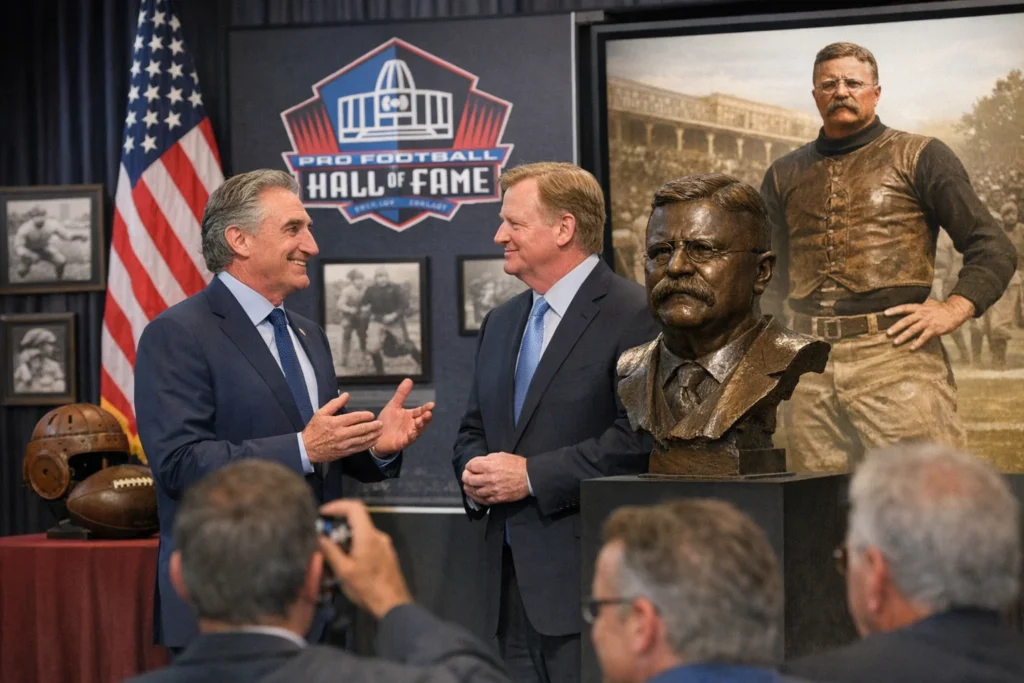
How TR’s Bully Pulpit Literally Rewrote the Rulebook
Roosevelt’s White House summit forced America’s top football powers to act. By 1906, a new intercollegiate conference — the direct forerunner of today’s NCAA — adopted sweeping rule changes: the forward pass was legalized, dangerous mass formations were abolished, a neutral zone between offense and defense was created, and first-down distance was extended to 10 yards.
Football fatalities dropped immediately — from 18 in 1905 to 11 in each of the following two years. The sport survived. It grew. It eventually became the most-watched, highest-grossing sport in America. None of that happens without the man in the Oval Office using his “big stick” on the gridiron’s behalf.
As one Harvard coach later recalled, without Roosevelt’s chain of events, “there might now be no such thing as American football as we know it.” That is the case the Trump administration is now making to Roger Goodell and the Hall of Fame selectors.
Why the Hall’s Rules Now Make This Possible
Until recently, Roosevelt’s induction would have been constitutionally impossible — the Hall of Fame only recognized players and coaches. But in early 2024, the selection process was updated to formally include a Contributor category: individuals who made outstanding contributions to professional football in capacities other than playing or coaching.
Under that definition, Roosevelt’s case is unusually strong. In October 2025, 21 Contributor candidates advanced one step closer to election for the Hall’s Class of 2026 — meaning the timing of Burgum’s push is no coincidence. The window is open, and the Trump administration is walking through it.
Burgum, who as North Dakota’s governor personally invested over $1 million of his own money into the Theodore Roosevelt Presidential Library, has long championed TR’s image. His Hall of Fame pitch is part of a broader effort to cement Roosevelt’s legacy as a symbol of American toughness, reform, and national character.
“Keep it a secret, keep your fingers crossed. But I think we’re going to see Theodore Roosevelt inducted into the Pro Football Hall of Fame.”
— Interior Secretary Doug Burgum, National Portrait Gallery, April 17, 2026
The Backlash — and Why It Doesn’t Kill the Idea
Not everyone is applauding. Critics on social media were quick to point out the irony of an administration that has rolled back public land protections — a cornerstone of Roosevelt’s conservationist legacy — now rushing to honor him in a sports hall. Democratic strategists called the move performative. Political observers called it perplexing.
But here’s the thing: the historical case for Roosevelt stands entirely on its own merits, separate from today’s politics. The NFL itself has acknowledged that Roosevelt’s 1905 interventions were pivotal to the sport’s survival — a point historians, sports experts, and the Hall of Fame’s own records support without reservation.
Theodore Roosevelt Pro Football Hall of Fame Trump 2026: Whether driven by politics or genuine historical appreciation, if Theodore Roosevelt does walk into Canton in 2026 — the same year America celebrates its 250th birthday — it would be one of the most fitting, stranger-than-fiction moments in sports history. A president who saved football. Finally honored by football.
Disclaimer: This article is published for informational and editorial purposes only, based on publicly available reporting as of April 2026. TrenBuzz.com does not claim affiliation with the Pro Football Hall of Fame, the NFL, the Trump administration, or any individuals or organizations mentioned herein. Historical details about Theodore Roosevelt’s role in football reform are sourced from established public record. Content may be updated as events develop.