Published by TrenBuzz.com | May 3, 2026
Key Points at a Glance – Trump’s White House Quietly Cheers
- The Trump White House — the most tariff-aggressive administration in a century — is celebrating a huge surge in foreign imports as of May 2026.
- The imports being cheered are AI-related: computer servers, fiber optic cables, cooling systems, semiconductors, and data center construction materials — almost all from abroad.
- Business investment tied to AI rose more than 10% in Q1 2026 — the biggest leap in three years.
- Just four companies — Alphabet, Amazon, Meta, and Microsoft — plan to spend $700 billion in capital expenditures this year alone.
- Taiwan’s economy grew at 12% annually in Q1 2026 — powered almost entirely by US AI demand for TSMC chips.
- AI hardware prices are surging: electronic components rose 19% year-over-year, according to the Bureau of Labor Statistics.
- The AI import boom is exempt from the usual tariff hostility because Trump sees it as essential to America’s economic dominance.
- TSMC’s annual profit has roughly doubled in three years, hitting over $55 billion.
- The Commerce Department confirmed that half of the increase in final sales to domestic purchasers in Q1 2026 came from AI hardware and software.
- The irony is stark: the president who hates imports is presiding over one of the largest import booms in US history — driven entirely by AI.
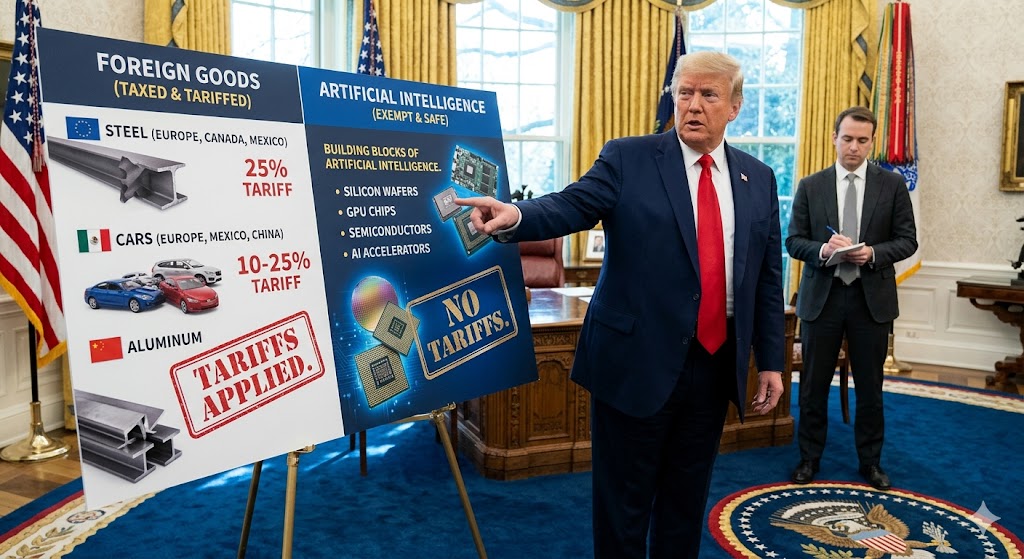
He taxes steel. He tariffs cars. He threatens to hit Europe, Canada, Mexico, and China. But there is one category of foreign goods the Trump White House will not — and cannot — bring itself to fight: the building blocks of artificial intelligence.
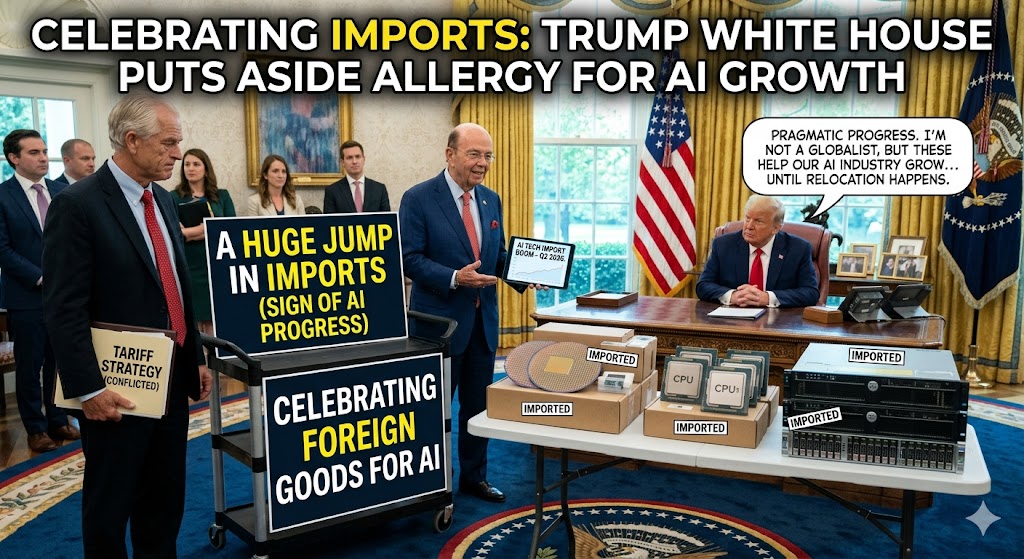
The Trump White House this week put aside its customary allergy to foreign goods and celebrated a huge jump in imports. No, President Donald Trump has not switched to the globalist team. He remains an avowed tariff fan and still wants offshore factories to relocate to the United States. But that won’t happen quickly, if ever. So the administration is welcoming a surge of foreign products as a sign of progress in developing the artificial intelligence industry.
The Numbers That Tell the Whole Story
Business investment — much of it linked to the AI boom — rose by more than 10 percent in the first quarter, the biggest leap in three years, the Commerce Department said Thursday. Most of the computer servers, fiber optic cables, and cooling equipment needed to build AI’s massive data centers come from abroad. Even some of the construction materials used to erect the warehouselike structures are foreign.
Just four companies — Alphabet, Amazon, Meta, and Microsoft — expect to devote $700 billion this year to capital expenditures, according to their recent earnings calls. That’s more than the quartet, plus Nvidia, Oracle, and TSMC, spent over the past three years.
Taiwan Is the Biggest Winner — By Far
Ground zero for the AI boom may lie in the US, but the gargantuan investment flows involved are spilling well beyond US borders. Thanks largely to AI, the Taiwanese economy grew at an annual rate of 12 percent in the first quarter. Home to Taiwan Semiconductor Manufacturing Co. (TSMC), one of the world’s top chipmakers, Taiwan has emerged as perhaps the most important node in the global AI supply chain.
Japan has roughly five times as many people as Taiwan. Yet Taiwan in February shipped more than twice as many goods to American customers, many of them tied to AI. That wasn’t true one year ago. TSMC’s annual profit roughly doubled in three years to more than $55 billion.
The Price Surge Nobody Is Talking About
Surging demand is pushing prices up for some inputs. Over the past year, producers of electronic components and accessories have raised prices by more than 19 percent, according to the Bureau of Labor Statistics. Amazon has seen sharp increases in the price of items, including computer memory. “I think everybody knows that the cost of these components, particularly memory, has skyrocketed,” Andy Jassy, Amazon’s chief executive, told investors on Wednesday.
That 19% price surge on electronics is — by any economic definition — inflation. The same administration that blamed Biden-era inflation on spending excess is now presiding over its own import-driven tech price spiral.
The Stock Market Is Betting Big on AI’s Import Addiction
Investor enthusiasm for anything associated with AI powered the S&P 500 index to a nearly 30 percent gain over the past year. But with businesses increasingly replacing employees with technology, earnings may keep rising to support even higher share values. “If you assume that AI is sort of structurally going to keep profits elevated as a percent of GDP, then I think there’s no particular reason the stock market is overvalued,” said one senior analyst.
The Tariff Carve-Out — What’s Actually Exempt
Trump imposed tariffs under Section 232 on semiconductors — but exempted chips imported to support the buildout of the US technology supply chain or to bolster domestic manufacturing capacity. Semiconductors used for data centers, research and development, and non-data center consumer applications are exempted — creating a carve-out tailor-made for the AI industry.
The result is a two-tier tariff world: punishing steel, cars, and consumer goods from Europe — while waving through the foreign-made chips and servers that power the next industrial revolution.
The Bottom Line — America’s AI Addiction Is Global
The AI boom is real, it’s enormous, and it is irreversibly international. TSMC in Taiwan. Memory chips from South Korea. Fiber infrastructure from Japan. Data center cooling systems from Germany. The more America spends on AI, the more America depends on the very global supply chains its president has spent two years trying to dismantle.
That means the US import bill is likely to grow again in 2026. The Commerce Department confirmed that half of the increase in final sales to domestic purchasers in Q1 2026 came from AI-related computer hardware and software buys.
The tariff-loving president has found his exception — and it’s wired, coded, and made almost entirely overseas.
Disclaimer: This article is for general informational and news reporting purposes only. All data, corporate spending figures, and economic statistics referenced are based on publicly available and credible sources including the Washington Post, Bureau of Labor Statistics, Commerce Department Q1 2026 report, and company earnings calls as of May 2, 2026. TrenBuzz.com does not provide financial or investment advice. Readers are encouraged to consult qualified financial advisors and follow credible economic sources for real-time updates.