Published by TrenBuzz.com | July 8, 2026 | BREAKING LEGAL NEWS
Key Points at a Glance – Washington Post Lawsuit Ruling
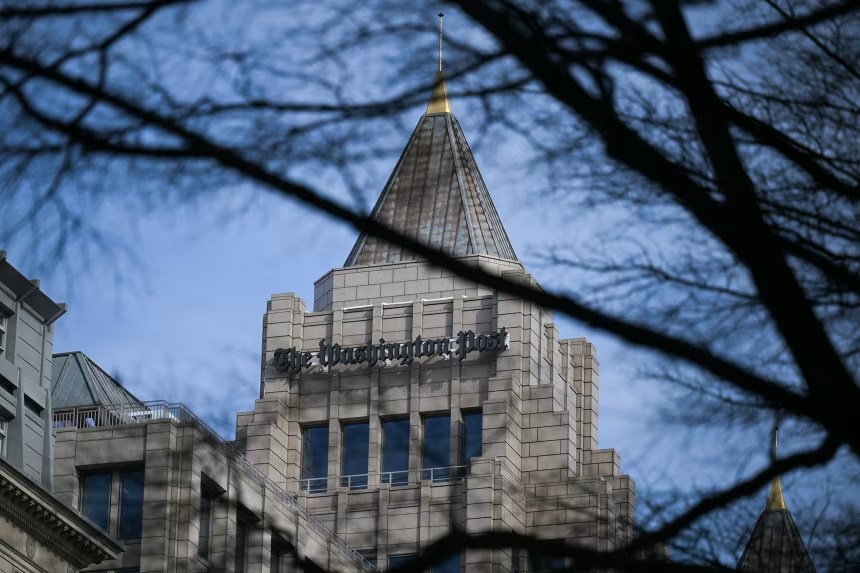
- US District Judge Thomas Barber in Tampa threw out Trump Media and Technology Group’s $3.8 billion defamation lawsuit against The Washington Post on July 7, 2026.
- The judge wrote in a summary minute order that Trump Media “failed to present evidence that would allow a jury to find by clear and convincing evidence” that The Post published statements with “actual malice.”
- The 2023 lawsuit centered on a Post article titled “Trust linked to porn-friendly bank could gain a stake in Trump’s Truth Social,” which alleged TMTG paid a $240,000 finder’s fee to a brokerage.
- While awaiting the ruling, The Post published a correction in May 2026 admitting the finder’s fee detail was wrong, but maintained the correction was “based on The Post’s reporting at the time of publication.”
- Trump Media called the correction a “win” and said it is considering an appeal.
- This is the fourth Trump-affiliated lawsuit against major media to collapse in 2026, joining dismissed suits against The Guardian, The Wall Street Journal, and ABC News.
Washington Post Lawsuit Ruling: Why “Actual Malice” Was Always the Insurmountable Wall
The legal standard at the center of every major Trump media lawsuit is the actual malice rule established in the 1964 Supreme Court case New York Times v. Sullivan. Under that rule, public figures suing for defamation must prove the publisher either knew the information was false at the time of publication or acted with reckless disregard for whether it was true.
Judge Barber’s ruling stated plainly that “a reporter need not engage in such a thorough investigation to dispel allegations of actual malice. What matters is whether there is clear and convincing evidence that the reporter actually knew, at the time of publication, that the statements were false.”
That standard is not impossible to meet. But it requires evidence that a journalist knowingly published a lie. Three years of discovery produced no such evidence against The Washington Post.
The Correction That Did Not Save the Lawsuit
The May 2026 correction to the original 2023 article is the most revealing part of this entire case. Discovery, the same legal process that allowed Trump Media’s lawyers to review Post internal communications, established that the finder’s fee detail was incorrect. So The Post corrected it.
Trump Media said that proved they were right all along. Judge Barber said it proved the opposite: that the Post relied on its reporting and corrected the record when discovery revealed an error. That is precisely what journalists are supposed to do, and that behavior cannot constitute actual malice under Sullivan.
The Bigger Picture: Four Collapsed Media Lawsuits in Six Months
A defamation lawsuit against The Guardian and other defendants was thrown out by a different Florida judge last November. Trump Media initially filed an amended complaint, but then dropped the matter altogether in April. In April, a federal judge dismissed Trump’s personal defamation lawsuit against The Wall Street Journal. Trump refiled that suit in May.
Trump also has pending litigation against the BBC, The New York Times, and the Des Moines Register. None of those cases have yet reached the summary judgment stage. The Barber ruling gives each of those defendants a new and authoritative roadmap for the arguments that just sent a $3.8 billion case home in a single minute order.
🔗 [Also Read: “Catherine Herridge FBI Source Dispute: $800 a Day Fine and Supreme Court Refuses to Block It” | TrenBuzz.com]
🔗 [“Trump Media Q1 2026 Loss of $406 Million: Truth Social’s Revenue Problem” | TrenBuzz.com]