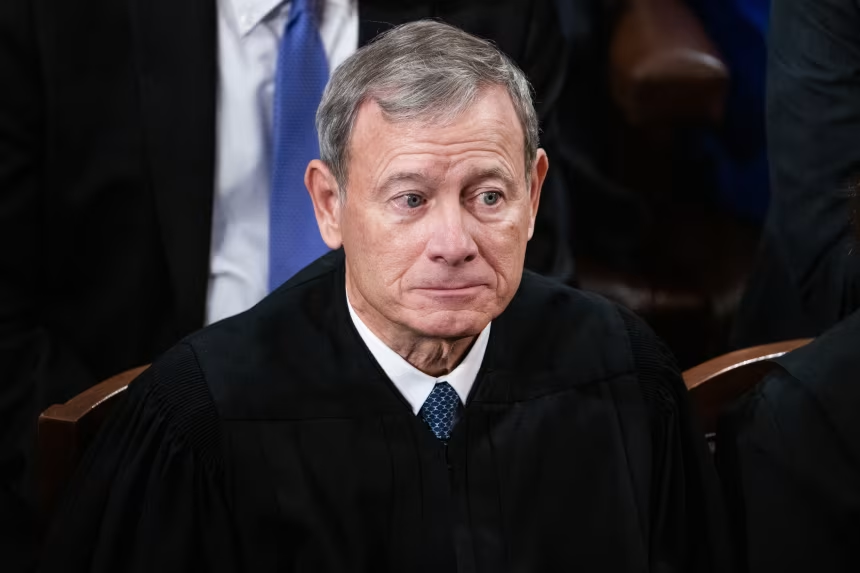
Key Points: John Roberts White House Dissent
- John Roberts White House dissent breaks sharply from his own conservative-appointed colleagues
- The Chief Justice called Trump’s $400 million ballroom construction “likely unlawful”
- Roberts joined all three liberal justices in a striking 5-4 ideological split
- His six-page dissent quoted Winston Churchill while defending the White House’s historic architecture
Chief Justice John Roberts just did something he rarely does, publicly break from the court’s Republican-appointed majority on a case directly involving Trump.
What The John Roberts White House Dissent Actually Says
The Supreme Court ruled 5-4 Monday, allowing Trump’s controversial East Wing ballroom construction to continue while the underlying legal challenge plays out in lower courts.
Here’s the notable exception to that majority. Roberts, appointed by Republican President George W. Bush, joined Justices Sonia Sotomayor, Elena Kagan, and Ketanji Brown Jackson in full dissent.
Writing on behalf of all four dissenters, Roberts stated plainly that the $400 million ballroom project is “likely unlawful,” directly rejecting the administration’s core legal argument.
Here’s the specific reasoning the majority relied on instead. The other five Republican-appointed justices issued an unsigned “per curiam” opinion, ruling narrowly that the plaintiff challenging the project likely lacks legal standing to sue at all.
Why Roberts Rejected The Administration’s Argument
Here’s the legal theory Roberts specifically dismantled in his dissent. The Trump administration had argued the ballroom construction fell within existing congressional appropriations meant for “ordinary Executive Residence maintenance and repairs.”
Roberts wasn’t persuaded. He wrote that a routine maintenance appropriation “likely does not authorize the President to use hundreds of millions of dollars in private donations to tear down the East Wing” and construct an entirely new complex.
That distinction matters enormously for separation of powers. Roberts argued the ruling effectively lets the executive branch bypass Congress’s constitutional authority over federal spending and property decisions.
“Today’s decision is no victory for the separation of powers,” Roberts wrote, framing his objection as institutional rather than personal or political.
The Historic Preservation Argument At The Case’s Core
Here’s the underlying lawsuit driving this entire dispute. Preservationist Carolyn Hoagland sued after the administration demolished the historic East Wing to build the new structure, which includes both an underground military installation and an aboveground ballroom.
Roberts sided with her standing to sue directly, drawing an interesting legal comparison in his opinion. He wrote that a historic preservationist can suffer real, “concrete, particularized” harm from a building’s transformation, just as “an environmentalist can sustain a concrete, particularized aesthetic injury” from an endangered species’ extinction.
Here’s where Roberts’s own personal interests seemed to shine through his legal reasoning. Known for regularly telling audiences he once considered pursuing a history PhD rather than law school, Roberts wove historical and architectural reverence throughout his dissent.
He quoted Winston Churchill’s famous 1943 wartime address directly: “We shape our buildings, and afterwards our buildings shape us.” Roberts added his own conclusion afterward, writing, “All the more reason to ensure that those responsible follow the rules in deciding what to tear down and what to build up at the People’s House.”
Why This Case Sits Alongside Roberts’s Broader Record
Here’s important context for understanding just how unusual this dissent actually is. Roberts authored the court’s landmark 2024 presidential immunity ruling, a decision widely seen as providing Trump significant legal protection during his campaign to return to office.
That earlier ruling drew sharp criticism from legal experts who warned it effectively placed the presidency above ordinary criminal accountability, delaying serious legal proceedings tied to the 2020 election.
Given that history, Roberts’s willingness to break from his own conservative colleagues on this ballroom case surprised many court watchers, who’ve generally viewed him as deferential to executive authority throughout Trump’s second term.
Here’s a procedural detail worth understanding too. Roberts is the justice who initially handles emergency litigation originating from Washington, DC courts, meaning he’d already issued a temporary administrative stay allowing construction to continue before Monday’s full ruling.
A DC appeals panel had previously upheld a preliminary injunction against the project on August 7, with judges citing the clear lack of congressional authorization, over a dissent from a Trump-appointed judge on that same panel.
What This Means Going Forward
With construction now proceeding despite Roberts’s warnings, and the underlying legal question of the ballroom’s ultimate legality still unresolved in lower courts, this case sets up a genuinely consequential test of how far executive authority extends over federal property and spending.
Trump celebrated Monday’s outcome publicly, framing it as a clear victory, even as the chief justice himself warned the ruling undermines the very separation of powers the Constitution was designed to protect.