Key Points: White House Bunker
- The White House bunker fight took a new turn this week after reporting revealed a nuclear-hardened facility already exists beneath the building.
- Trump’s team argues a new underground bunker is urgently needed for presidential safety, the same claim now driving his Supreme Court appeal.
- Former officials say that argument gets harder to defend once you account for the secret bunker built after 9/11.
- The overall ballroom and bunker project has ballooned to roughly 600 million dollars, with taxpayers covering a large share.
The White House Bunker Debate Just Got A Lot More Complicated
The White House bunker at the center of Trump’s ballroom lawsuit is not actually the first one built underneath the building. That detail, revealed this week, is reshaping the entire legal argument the administration has leaned on for months.
According to new reporting, a nuclear proof facility was constructed in secret beneath the White House after the September 11 attacks. Former officials say that existing structure directly complicates Trump’s claim that a brand new underground complex is urgently required for his safety.
What’s Actually Being Built Right Now
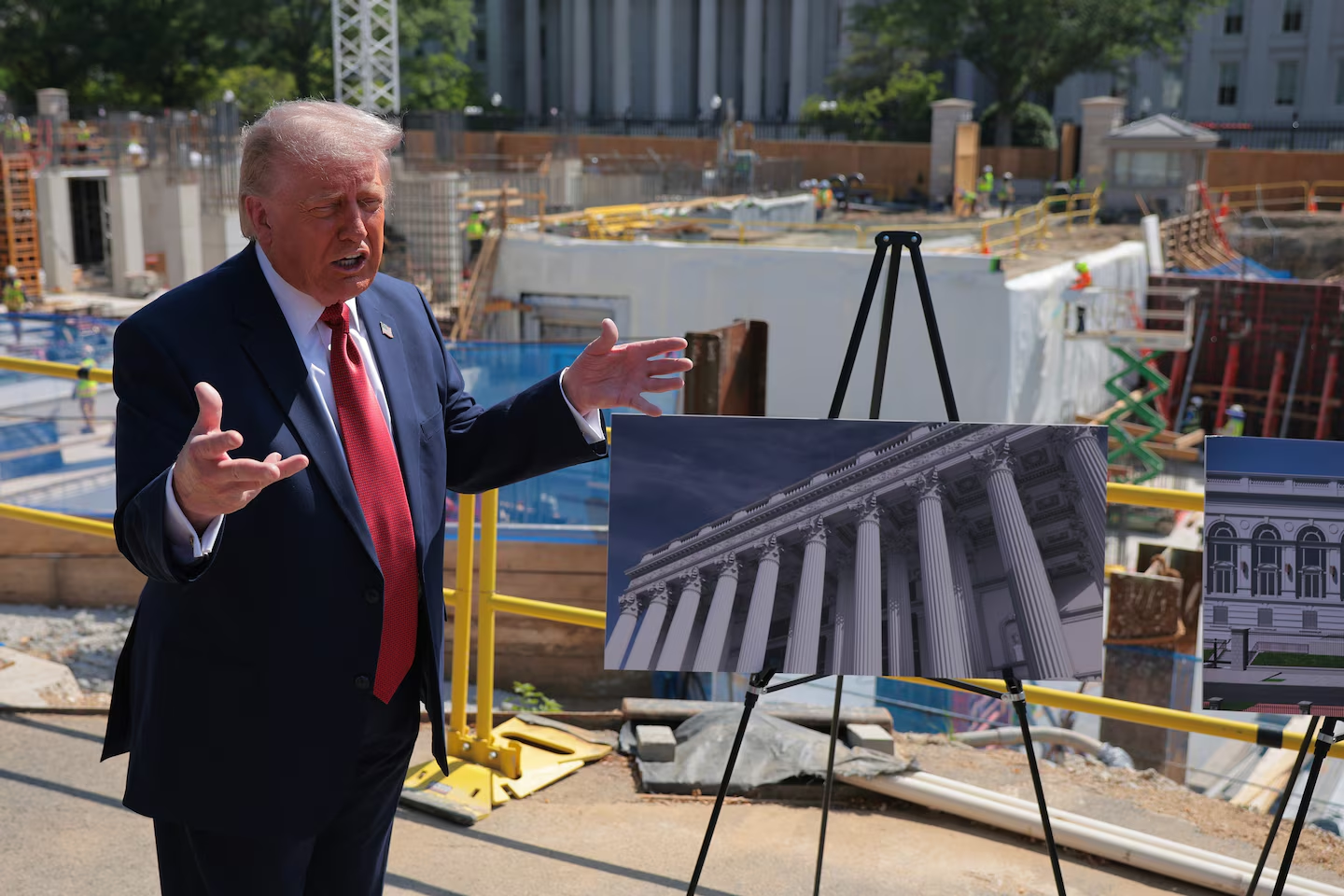
The current project goes far beyond a simple event space. Trump has described the underground portion as extending six stories deep, featuring drone proof construction, bomb shelters, hospital grade medical facilities, and what officials call military grade air filtration systems.
Court filings from the National Trust for Historic Preservation describe the complex using blunt language, calling it a facility built for “top secret military installations” rather than simply a renovation tied to hosting state dinners and large events.
The ballroom itself, sitting above this underground complex, spans 90,000 square feet and is designed to seat roughly 650 people, more than triple the capacity of the East Room it is meant to replace.
Why The Existing Bunker Changes The Legal Argument
Here is the detail most coverage has treated as a side note rather than the central issue. If a secure, nuclear hardened facility already exists beneath the White House, the argument that presidential safety requires this new construction becomes much harder to sustain in court.
Former officials familiar with the earlier post 9/11 facility say its existence was rarely discussed publicly, which is part of why so few people outside government were aware it existed until this reporting surfaced this week.
That timing matters enormously, since the entire Supreme Court fight currently hinges on the administration’s claim that halting construction poses “unacceptable risk” to presidential safety and continuity of government operations.
The Supreme Court’s Role So Far
Chief Justice John Roberts issued an administrative stay Friday, allowing construction to continue for now while the broader legal fight plays out. That stay could still be lifted by the full court, meaning nothing about this case is settled yet.
Solicitor General John Sauer has argued forcefully that delaying the project risks the president’s security and undermines separation of powers, framing the entire complex as an “integrated military complex” rather than a standard renovation project.
The National Trust for Historic Preservation, which brought the original lawsuit, has pushed back directly, arguing the injunction never blocked bunker construction itself, only construction of the ballroom without congressional approval.
The Money Behind The Project
Cost estimates for the combined ballroom and bunker project have climbed to roughly 600 million dollars, nearly triple the original 200 million dollar figure announced when the project was first unveiled last year.
Roughly 352 million taxpayer dollars were redirected toward the project in June, despite Trump’s original promise that private donors alone would cover the entire cost of construction.
What Comes Next
With construction reportedly 65 percent complete and crews working around the clock, the practical reality on the ground may outpace the legal process entirely, regardless of how the Supreme Court eventually rules on the underlying case.
Expect continued scrutiny over exactly what already existed beneath the White House before this project began, especially as more officials familiar with the earlier facility come forward with additional detail.
The Bottom Line
The White House bunker story is no longer just about cost overruns or construction delays. It has become a genuine test of whether the administration’s central safety argument can survive contact with its own building’s history.
Trenbuzz will continue following this story as the Supreme Court case and construction both move forward simultaneously.