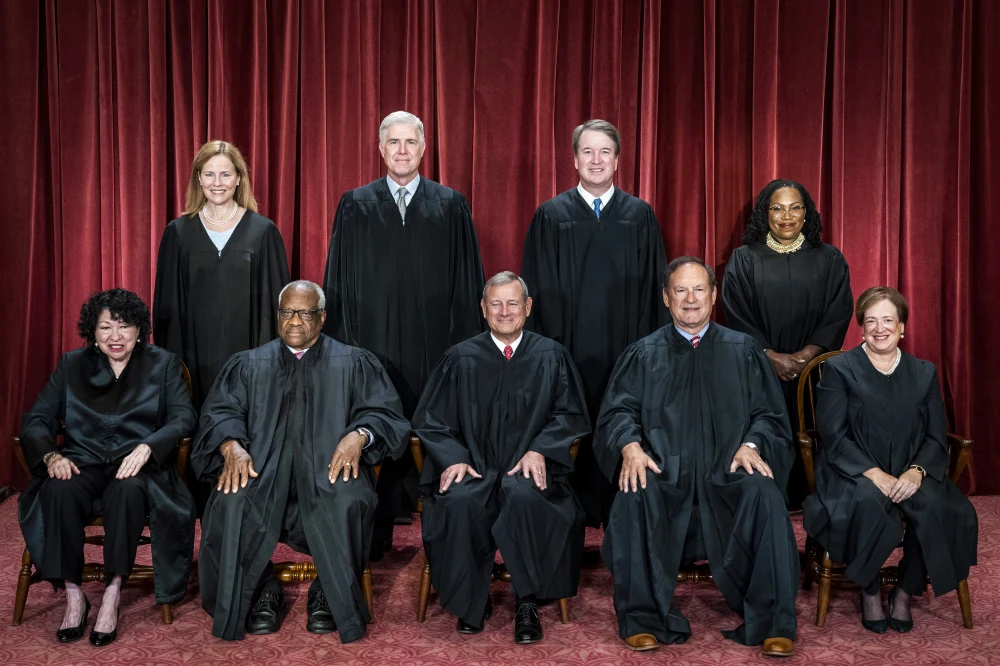
Key Points: House Vote Fails
- The House failed to pass a constitutional amendment locking the Supreme Court at nine justices
- The vote fell 212-206, far short of the two-thirds majority required
- Only one Democrat crossed party lines, while every voting Republican supported it
- This vote landed just one day after Chief Justice Roberts’s own public dissent from his colleagues
Congress just spent an entire day arguing over a number, nine, and in doing so, revealed something more interesting than the vote count itself.
What The House Actually Voted On
Rep. Andy Biggs of Arizona introduced a joint resolution Wednesday that would have permanently written the Supreme Court’s size into the Constitution.
Here’s the exact language at stake. The amendment would have added a single sentence: “The Supreme Court of the United States shall be composed of nine justices consisting of one chief justice and eight associate justices.”
The vote fell 212-206, nowhere close to the two-thirds majority any constitutional amendment requires. Only Rep. Don Davis of North Carolina crossed over to vote with Republicans.
Here’s a detail that reveals just how symbolic this vote really was. Even if every single House member had shown up and voted yes, Republicans’ 218 seats still couldn’t have cleared the constitutional two-thirds threshold without substantial Democratic support.
Why This Vote Happened At All
Here’s the political trigger behind this whole exercise. Democrats have grown increasingly vocal about expanding the court, with Rep. James Clyburn publicly endorsing a 13-justice court just days earlier on NBC’s “Meet the Press.”
House Speaker Mike Johnson framed the vote explicitly as forcing Democrats “on the record,” telling reporters Tuesday that Republicans wanted to eliminate any future possibility of court expansion.
Democratic leadership pushed back on that framing entirely. Whip Katherine Clark argued the amendment would strip Congress “of yet another constitutional authority,” pointing to what she called Republicans’ pattern of surrendering war powers and spending authority to Trump already.
Rep. Jamie Raskin went further during floor debate, calling the current court “profoundly partisan and lopsided” and describing the Senate’s refusal to hold hearings for Merrick Garland as “court packing on steroids” that predates any Democratic response.
Here’s The Angle Nobody’s Connecting
This is where the story gets genuinely interesting, and where most coverage has stopped short. This vote happened Wednesday, September 2. One day earlier, Chief Justice John Roberts had authored a dissent breaking from his own conservative colleagues in the White House ballroom case.
Think about what that timing actually means. The same week House Republicans argued that locking the court’s size protects it from becoming “another political battleground,” the sitting Chief Justice was publicly demonstrating that ideology doesn’t fully predict outcomes on this court anyway.
Here’s the deeper irony. Republicans’ entire argument for freezing the court at nine justices rests on the premise that the current 6-3 conservative majority represents a stable, principled bloc worth protecting from political tampering.
Roberts’s ballroom dissent complicates that premise directly. If the Chief Justice himself is willing to break from five fellow Republican appointees on a case involving Trump’s own White House construction project, the “6-3 conservative majority” framing driving this entire debate is less monolithic than either party’s talking points suggest.
Neither side’s floor speeches Wednesday mentioned Roberts’s dissent at all. Republicans argued for stability using language implying ideological predictability, while Democrats argued for reform using language implying the court is already captured, and both arguments arguably got undercut by the same justice’s ruling from 24 hours earlier.
What Happens Now That The Amendment Failed
Here’s the practical reality following this vote’s failure. Congress technically retains the same authority it’s always had, the ability to change the Supreme Court’s size through ordinary legislation, not a constitutional amendment.
That’s actually significant context missing from most headlines. Congress has changed the court’s size seven times since 1789, expanding and shrinking it before settling on nine seats in 1869, where it’s remained for 157 years.
A simple statute could theoretically expand the court again, though that would require overcoming a presidential veto, something virtually impossible while Trump holds office and Republicans control enough of Congress to sustain it.
With midterm elections approaching in November and this vote now permanently on the record for every House member, Wednesday’s failed amendment guarantees the Supreme Court’s size, and the question of who really controls its ideological direction, remains a live campaign issue heading into the fall.